
Pyridine and six-membered heterocycles
Pyridine is isoelectronic with benzene, but its nitrogen, more electronegative than carbon, withdraws electron density from the ring: it is a π-deficient heterocycle. Its lone pair, in an sp2 orbital in the plane of the ring, is not part of the aromatic system and makes it basic and nucleophilic. Pyridine reacts poorly with electrophiles (at C3) and well with nucleophiles (at C2 and C4).
Basicity and nucleophilicity
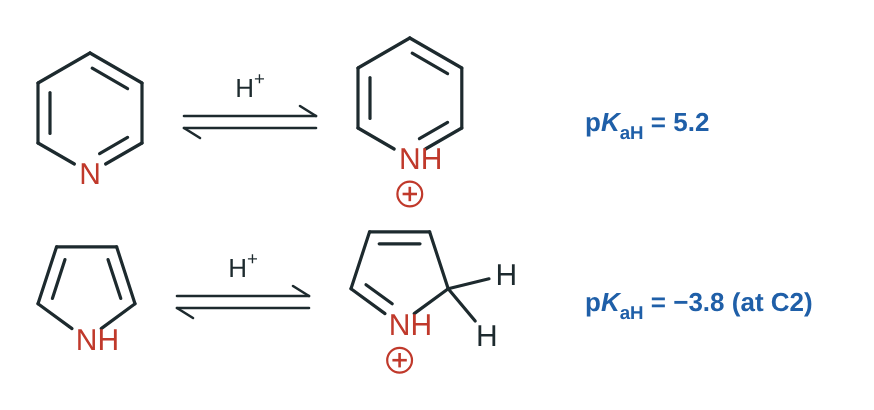
The pyridinium ion has a pKa of 5.2: pyridine is much less basic than an aliphatic amine (piperidine, 11.1), because the lone pair is in an sp2 orbital, with more s character, but it is protonated without losing aromaticity. Pyrrole, by contrast, is protonated only at C2, at the expense of its aromaticity. As a nucleophile, the pyridine nitrogen is alkylated by alkyl halides (pyridinium salts), acylated and oxidized to the N-oxide; that is why it is used as solvent and base in acylations.
Electrophilic substitution
Pyridine is less reactive than nitrobenzene: under the acidic conditions of nitration or sulfonation it is protonated, and the pyridinium ion repels the electrophile. The few reactions that succeed, at temperatures of about 300 °C and in low yields, take place at C3, because attack at C2 or C4 would place the positive charge of the σ-complex on a nitrogen with only six electrons. Donor groups (amino, methoxy) on the ring make substitution easier.
Nucleophilic substitution
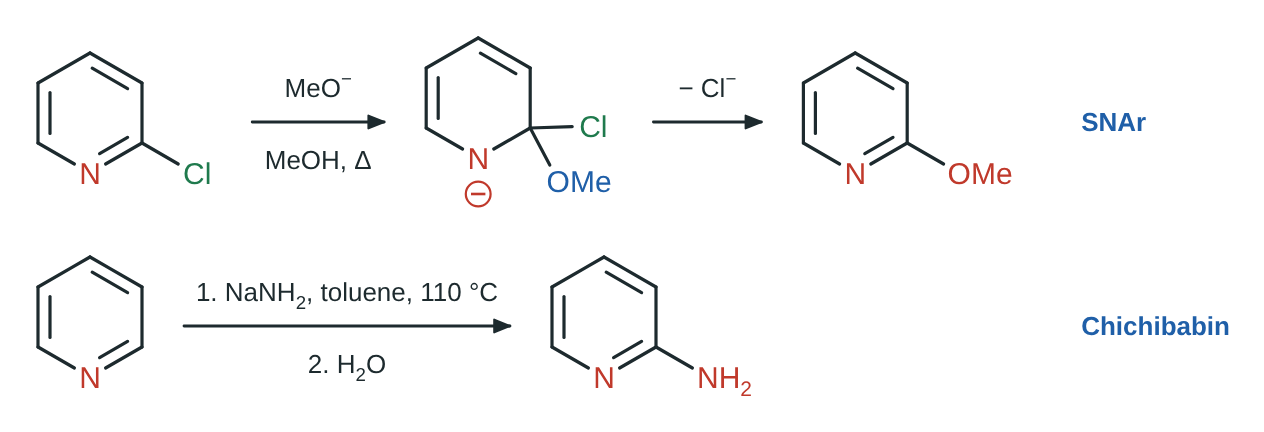
Nucleophiles attack C2 and C4, because the intermediate anion carries the negative charge on nitrogen. 2- and 4-Halopyridines behave like vinylogous acyl chlorides and undergo SNAr with alkoxides, amines and thiols under mild conditions; 3-chloropyridine does not. Without a leaving group, sodium amide introduces an amino group at C2 with loss of a hydride (Chichibabin reaction, 1914), and organolithiums also add at C2.
Pyridine N-oxides
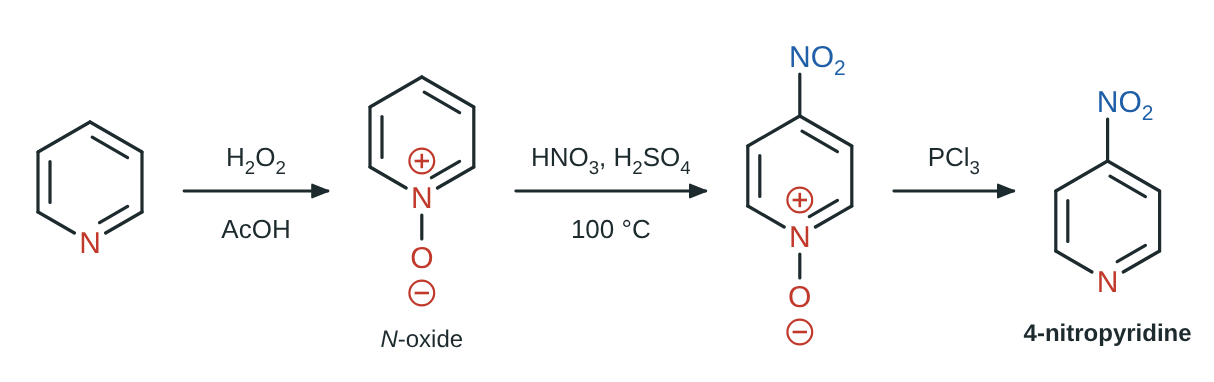
The N-oxide reverses the situation: the oxygen donates electron density to C2 and C4 by resonance and the ring is nitrated at C4 with mixed acid, in good yield. Phosphorus trichloride then removes the oxygen to give 4-nitropyridine; with iron in acetic acid both the nitro group and the N-oxide are reduced and 4-aminopyridine is obtained. N-Oxides also activate C2 and C4 towards nucleophiles (with POCl3 they give 2- and 4-chloropyridines).
Other six-membered heterocycles
With two nitrogens in the ring (the diazines: pyridazine, pyrimidine and pyrazine) the π-deficient character becomes stronger: they are less basic than pyridine and even more reactive towards nucleophiles. Pyrimidine is the core of cytosine, thymine and uracil, and 2- and 4-hydroxypyridines exist almost entirely as pyridones, their carbonyl tautomers.