
Fused heterocycles: indole and quinoline
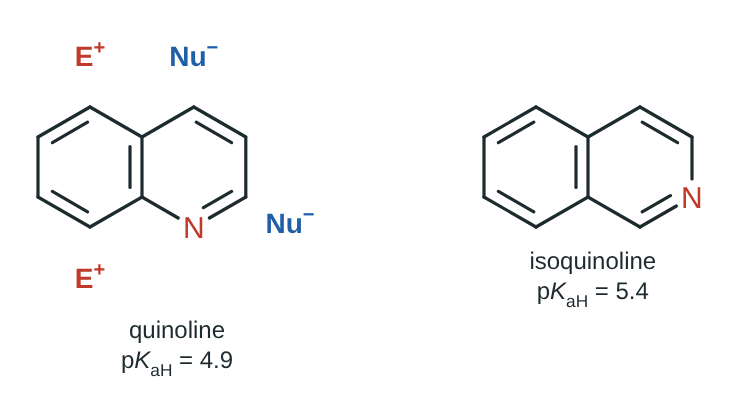
When a benzene ring is fused on, each heterocycle keeps its character, but the regioselectivity changes. Indole reacts with electrophiles at C3, not at C2 as pyrrole does. In quinoline, electrophiles attack the benzene ring (C5 and C8) and nucleophiles the pyridine ring (C2 and C4).
Indole
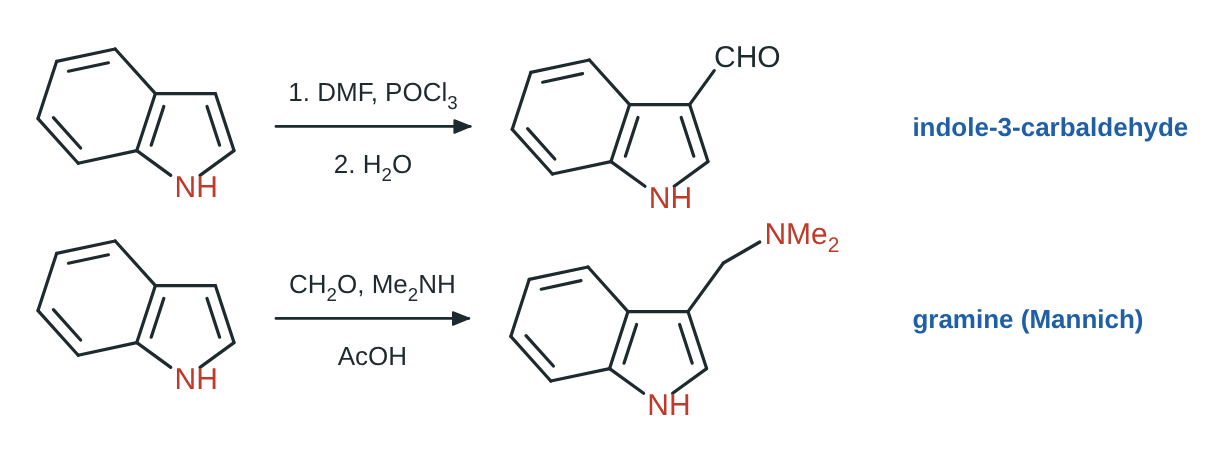
Indole, prepared by Adolf von Baeyer in 1866 by reduction of oxindole with zinc, is the core of tryptophan, serotonin, melatonin and thousands of alkaloids. Electrophilic attack at C3 gives a σ-complex in which the charge is delocalized onto nitrogen without breaking the benzene sextet; attack at C2 would force it to be interrupted. Like pyrrole, indole is not basic (it is protonated at C3, pKa ≈ −3.6) and its NH is weakly acidic.
Typical reactions at C3 are the Vilsmeier formylation, acylation and the Mannich reaction with formaldehyde and dimethylamine, which gives gramine. The dimethylaminomethyl group of gramine is a good leaving group: it is eliminated to form a 3-methyleneindolenine, a Michael acceptor that reacts with carbon nucleophiles.
Quinoline and isoquinoline
Quinoline (benzo[b]pyridine) and isoquinoline (benzo[c]pyridine) are bases similar to pyridine. In strong acid, the pyridine ring is protonated and deactivated, and nitration with mixed acid at 0 °C gives an almost 1:1 mixture of 5- and 8-nitroquinoline, the benzene positions furthest from nitrogen; isoquinoline is nitrated almost exclusively at C5. Nucleophiles (amide, organolithiums) attack C2 of quinoline and C1 of isoquinoline.
A strong oxidant (permanganate) attacks the more electron-rich ring: quinoline is oxidized to pyridine-2,3-dicarboxylic acid, and the pyridine ring survives. Quinoline was the basis of antimalarials, from quinine from cinchona bark to chloroquine; Zdenko Hans Skraup described its synthesis from aniline and glycerol in 1880.
Polycyclic hydrocarbons show the same pattern: naphthalene is substituted at the α position, the one that keeps an intact benzene sextet in the σ-complex. Review polycyclic hydrocarbons.