
Heterocycle synthesis: Paal-Knorr, Hantzsch and Fischer
Heteroaromatic rings are almost always built by condensation: a dicarbonyl compound, or an equivalent, reacts with an amine, an alcohol or a sulfide that provides the heteroatom, and loss of water closes the ring and aromatizes it. The Paal–Knorr, Hantzsch and Fischer syntheses, all from the 19th century, are still the most widely used.
Paal–Knorr synthesis
In 1884, Carl Paal and Ludwig Knorr independently described the formation of furans and pyrroles from 1,4-dicarbonyl compounds. With ammonia or a primary amine, the two carbonyls successively form a hemiaminal and an imine, the nitrogen closes the five-membered ring and loss of two molecules of water gives the pyrrole; with an acid, one carbonyl acts as an enol and the furan is formed; with phosphorus pentasulfide or Lawesson’s reagent, the thiophene.
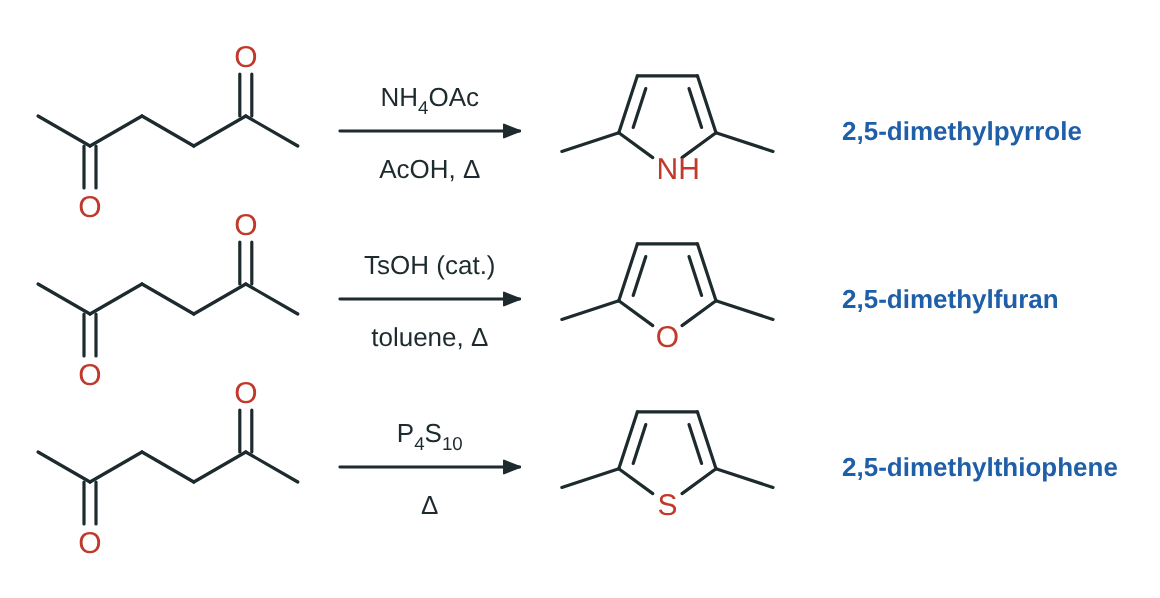
The difficulty lies in preparing the 1,4-dicarbonyl compound: by alkylation of an enolate with an α-haloketone, by Stetter addition or by ozonolysis. The industrial synthesis of atorvastatin, the best-selling cholesterol drug in history, builds its pentasubstituted pyrrole ring by a Paal–Knorr reaction.
Hantzsch pyridine synthesis
In 1881, Arthur Hantzsch combined two equivalents of a β-keto ester, an aldehyde and ammonia. One equivalent of keto ester gives the Knoevenagel product with the aldehyde; the other, with ammonia, an enamine; Michael addition of the enamine and cyclization form a 1,4-dihydropyridine, which is oxidized to the pyridine with nitric acid, DDQ or manganese dioxide. 1,4-Dihydropyridines are NADH analogues, and the Hantzsch ester is used as a reductant in organocatalysis.

Fischer indole synthesis
In 1883, Emil Fischer heated the phenylhydrazone of pyruvate with acid and obtained an indole. The arylhydrazone of a ketone with α hydrogens tautomerizes to an ene-hydrazine, which undergoes a [3,3]-sigmatropic rearrangement (like the Cope rearrangement): the N–N bond breaks and a C–C bond to the aromatic ring forms. The product rearomatizes, the NH2 nitrogen closes the five-membered ring and loss of ammonia gives the indole. The usual catalysts are zinc chloride, polyphosphoric acid or acetic acid.
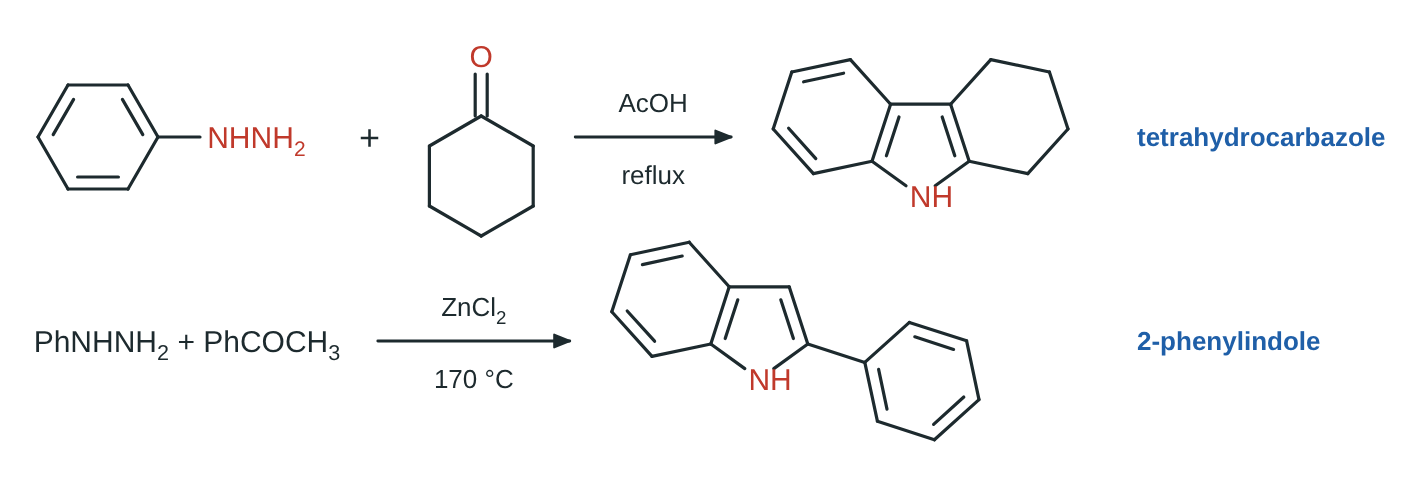
With unsymmetrical ketones, the more substituted ene-hydrazine usually predominates in strong acid and determines which indole is formed. The Fischer synthesis is used to manufacture the triptans against migraine, such as sumatriptan, and the anti-inflammatory indometacin.
Other syntheses
- Skraup (1880): aniline and glycerol, with sulfuric acid and an oxidant, give quinoline; glycerol is dehydrated to acrolein, which adds to the aniline.
- Bischler–Napieralski (1893): β-arylethylamides cyclize with POCl3 to 3,4-dihydroisoquinolines.
- Pictet–Spengler (1911): a β-arylethylamine and an aldehyde give, through an iminium ion, tetrahydroisoquinolines or, with tryptamine, tetrahydro-β-carbolines.
- Hantzsch thiazole synthesis: an α-haloketone and a thioamide give the thiazole.