
Protection of carboxyl groups
A carboxylic acid is protected as an ester or as an oxazoline. This suppresses its acidity (pKa ≈ 4–5), which is incompatible with strong bases, hydrides and organometallics.
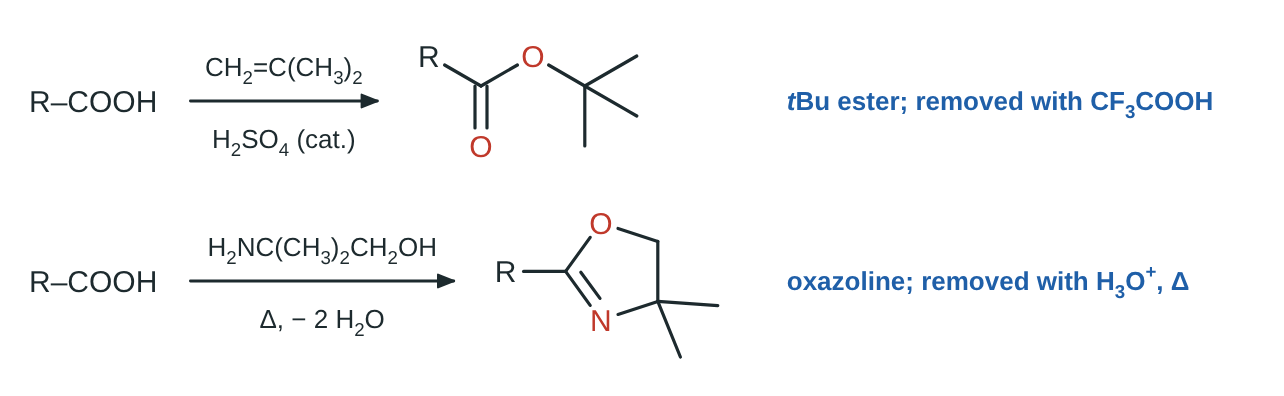
- Methyl ester: with methanol and acid or with diazomethane (or trimethylsilyldiazomethane); hydrolysed by LiOH or NaOH. It does not withstand organometallics or hydrides.
- tert-Butyl ester: with isobutene and sulfuric acid; its bulk shields it from nucleophilic attack and bases, and it is cleaved by trifluoroacetic acid via an SN1 mechanism (tert-butyl cation).
- Benzyl ester: with benzyl bromide and base; removed by hydrogenolysis under neutral conditions, orthogonal to the others.
- S-tert-Butyl thioester: very resistant to hydrolysis, it is activated by mercury(II) or silver(I) salts.
- 1,3-Oxazoline: Meyers' 4,4-dimethyloxazoline, formed with 2-amino-2-methylpropan-1-ol, withstands Grignard and organolithium reagents; it even directs ortho-lithiation in aromatic acids. It is hydrolysed with hot aqueous acid.
If a Grignard reagent is to react with a ketone in a molecule that contains a methyl ester, the ester must be changed into a tert-butyl ester or an oxazoline, or the ketone protected and the order of steps modified. Choosing the protecting group means reviewing all the conditions of the synthesis, including the final deprotection.