
The Knoevenagel reaction
The Knoevenagel condensation joins an aldehyde or ketone with an active methylene compound (two electron-withdrawing groups on the same CH2), catalysed by amines. It gives the α,β-unsaturated compound directly, like a crossed aldol condensation followed by dehydration.
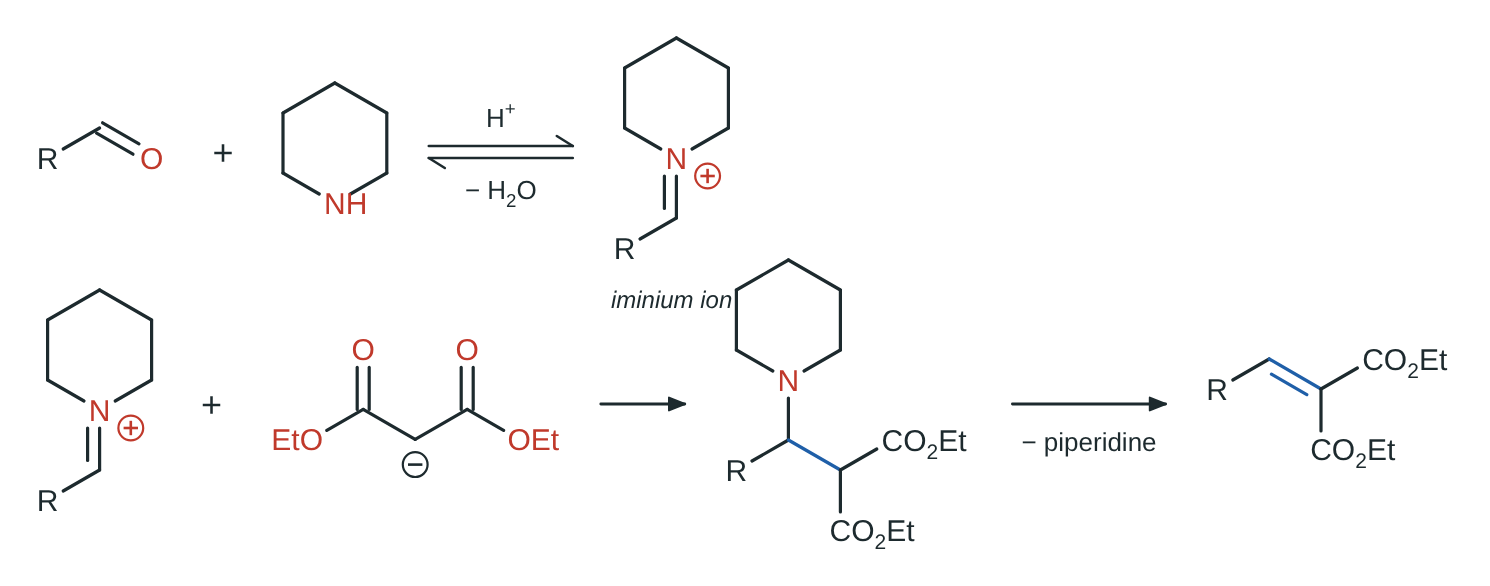
The reactions are catalysed by amines or by buffers made of an amine and an acid, and are known as Knoevenagel condensations. Iminium ions are intermediates: the reactive electrophile is probably the protonated imine, more electrophilic than the starting carbonyl compound, and the amine is eliminated at the end:
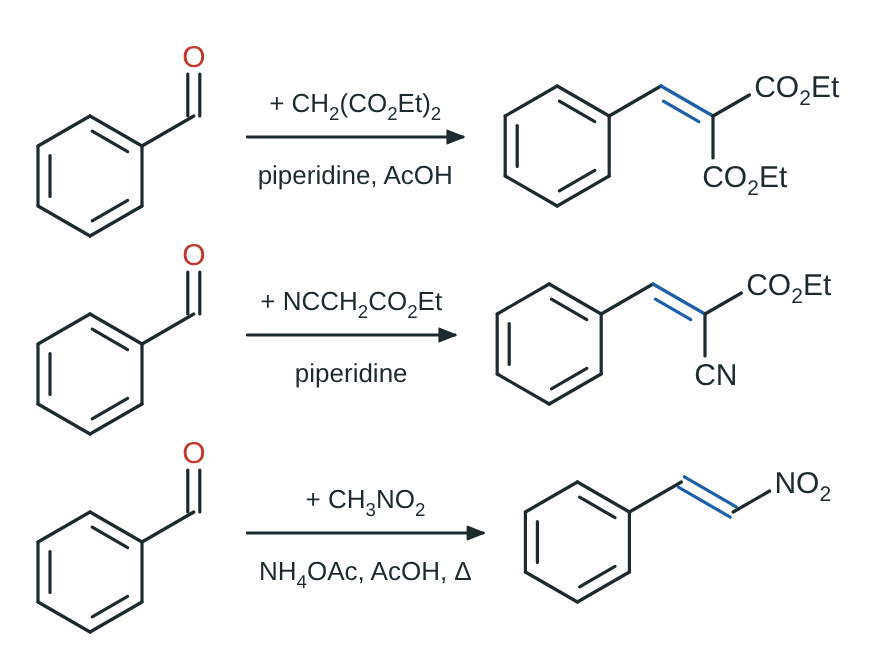
The carbon nucleophiles used under these conditions are rather acidic compounds with two electron-withdrawing groups: malonates, cyanoacetates and cyanoacetamide. Nitroalkanes also react well:
When the two electron-withdrawing groups are different, the more stable isomer is formed, with the bulkier group trans to the substituent of the aldehyde. With malonic acid in pyridine, condensation is followed by decarboxylation (Doebner modification); see the malonic synthesis in topic 6.