
Addition of N-acyliminium ions
N-Acyliminium ions, in which the nitrogen also carries an acyl group, are even more electrophilic than ordinary iminium ions. They react with weak nucleophiles such as silyl enol ethers or allylsilanes, and allow substituents to be introduced next to the nitrogen of lactams and carbamates.
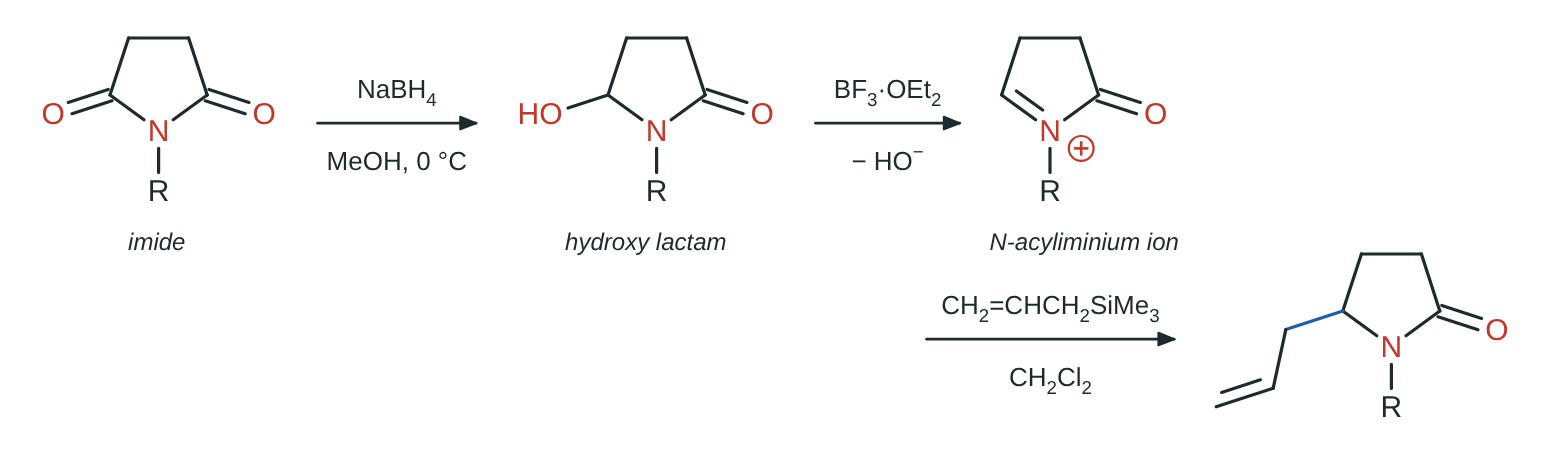
N-Acyliminium ions are normally prepared in the medium, in the presence of the nucleophile. There are several ways of generating them. Cyclic ones are obtained by partial reduction of imides, which gives hydroxy lactams (or, in alcohol, alkoxy lactams); a Lewis or Brønsted acid then removes the hydroxy or alkoxy group:
N-Acyliminium ions can also be obtained by oxidative decarboxylation of N-acyl-α-amino acids, such as proline derivatives, or by anodic oxidation of carbamates in methanol (Shono oxidation), which gives α-methoxy carbamates. They are electrophilic enough to react with enolate equivalents such as silyl enol ethers or isopropenyl acetate, and the additions can be made enantioselective by using enolates bearing chiral auxiliaries, such as N-acyloxazolidinones or N-acylthiazolidinethiones.