
Hydrolysis of Nitriles
Nitriles are hydrolysed in basic medium to carboxylic acids.
 ▶ Watch the video on YouTube
Therefore, the introduction of a nitrile group, by nucleophilic substitution (SN) with cyanide on a compound bearing a good leaving group, is an excellent method to obtain a carboxylic acid.

Remember that nucleophilic substitution reactions cannot always be achieved, depending on the structure of the R group.
Click here to recall how the aliphatic SN worked.
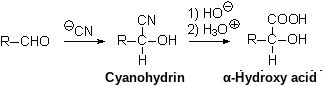
Another interesting possibility is the formation of a cyanohydrin by addition of cyanide to an aldehyde. Subsequent hydrolysis of the nitrile gives α-hydroxy acids.
Click here to preview the mechanism of nitrile hydrolysis, which belongs to the next chapter.