
Acid-Base Properties
The basicity of a nitrile group can be studied from the acidity of its protonated form.
Basicity of the nitrogen
A protonated nitrile is extraordinarily acidic and consequently its nitrogen is much less basic than that of an aniline or amine.

pKa = -10.0
The nitrogen's electron pair of a nitrile dwells very close to the nucleus in an sp orbital and is therefore very inaccessible.

pKa = 4.6
The nitrogen's lone electron pair of an aniline is partially delocalized towards the ring, thus making it less basic than an amine's or, conversely, making an anilinium cation more acidic than an ammonium one.

pKa = 10.6
The electron pair on an amine group is fully localized and therefore they are the most basic of this series.
Acidity of α-hydrogens
The α hydrogens to a nitrile are very weakly acidic, due to the poor delocalization of the negative charge towards the CN group.
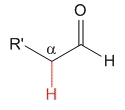
pKa = 17
Aldehyde's hydrogen does not exert any special effect and pKa = 17 can be taken as a reference acidity value for the α hydrogens to a carbonyl group.
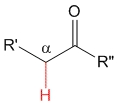
pKa = 20
Alkyl groups are electron releasing by inductive effect and therefore they destabilize the anion, thus making ketones' α hydrogens less acidic than aldehydes'.
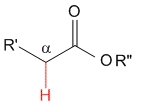
pKa = 25
Alkoxy groups are strong electron releasing by mesomeric effect and destabilize the anion even further, thereby causing the lowest acidity for esters in the studied series.
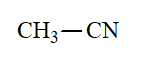
pKa = 31
The CN group bears the lowest capability to stabilize a negative charge generated at the α position.