
SolutionsElectrophilic Addition of Halogens
1. Intramolecular bromine and double elimination
Predict the result of the following reactions:


In the first case the nucleophile that opens the bromonium ion is the molecule's own OH, which attacks the more substituted carbon and forms a six-membered ring. In the second, the bulky base removes the hydrogens of the methyl groups (Hofmann-type elimination).
2. Cycloalkenes and the meso form
Explain why the reaction of cycloalkenes such as cyclobutene, cyclopentene or cyclohexene with Br2 never gives a meso form, but a racemic mixture.
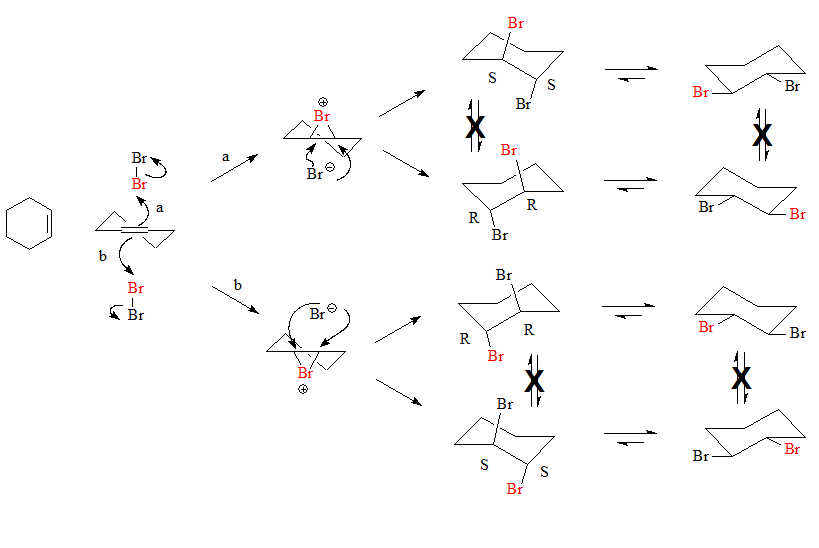
Bromine addition takes place with anti stereochemistry, giving the racemic mixture of the trans isomer. The meso form is the cis isomer, which cannot be obtained by an anti addition.
3. Halohydrins
Give the product of the reaction of propene with Br2 in water and explain its regiochemistry.
1-Bromopropan-2-ol. Water, present in large excess, opens the bromonium ion at the secondary carbon, which best supports the partial positive charge of the transition state.