
Examples
The examples in the literature are numerous and, in many cases, spectacular. The creation of two σ bonds in a single process ("two birds with a stone") has been kind of a revolution in Organic Chemistry.
 ▶ Watch the video on YouTube
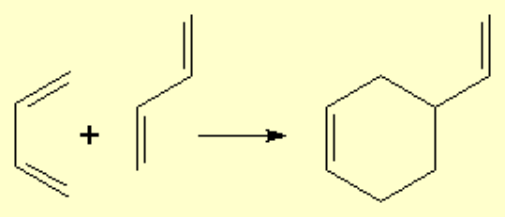
The diene can react with itself at relatively high temperature and pressure: half of the 1,3-butadiene molecules act as the diene and the other half as the dienophile, giving 4-vinylcyclohexene.

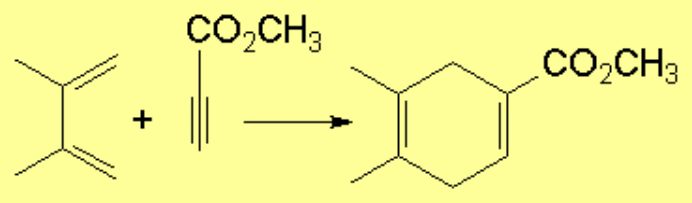
Alkynes can act as dienophiles. One of the π bonds of the triple bond is consumed, but the other one remains; that is why a 1,4-cyclohexadiene is obtained.

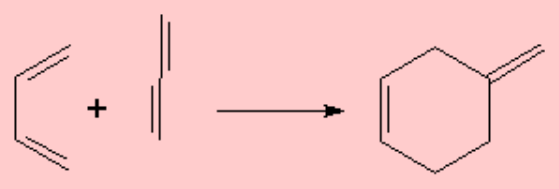
Allenes are very good dienophiles. In this way 4-methylidenecyclohexenes can be obtained.

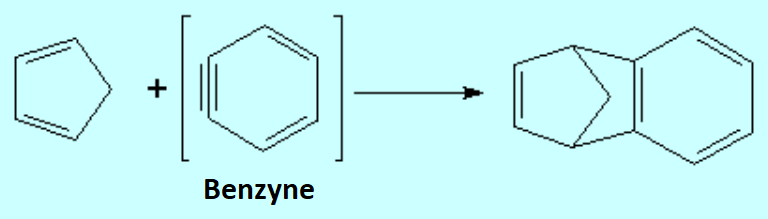
Benzyne is a reactive intermediate that has to be generated in situ. In the presence of a diene it undergoes the Diels-Alder reaction, giving an aromatic adduct.

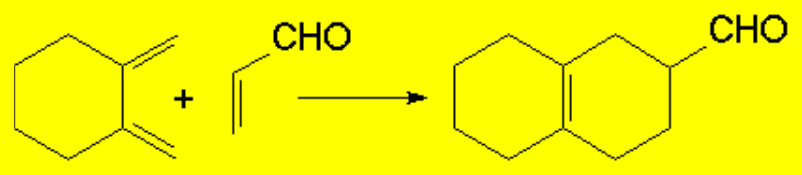
1,2-Bis(methylidene)cyclohexane (ortho-quinodimethane) has its double bonds locked in the s-cis arrangement. With a dienophile it gives a bicyclic compound.

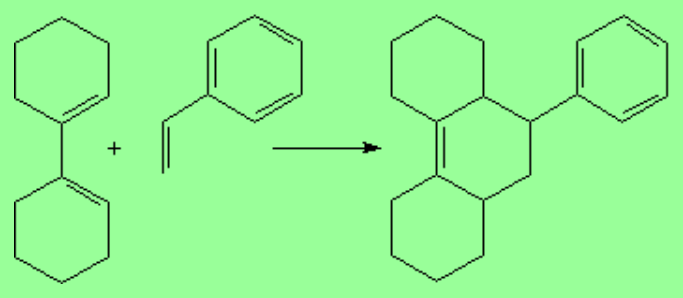
The diene may involve two rings. The s-cis arrangement is not locked, but such a diene can give a tricyclic compound.

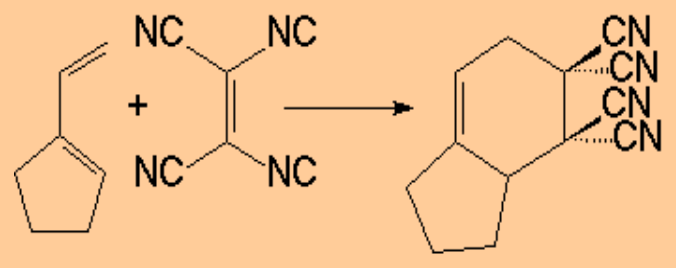
The diene can have an exocyclic double bond conjugated with an endocyclic one. The s-cis conformation is not locked, but such dienes give bicyclic compounds.

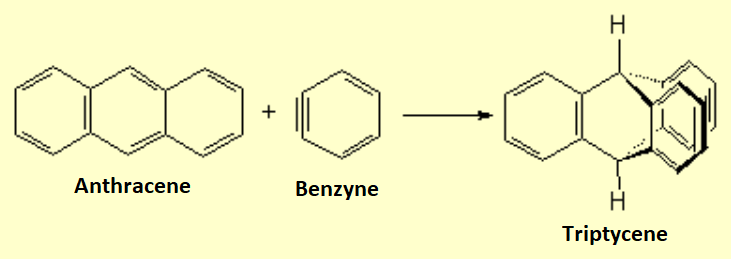
The central ring of anthracene can act as a diene because its aromaticity is the lowest of the three. If it reacts with benzyne, generated in situ, the Diels-Alder reaction gives triptycene, a blade-shaped compound.

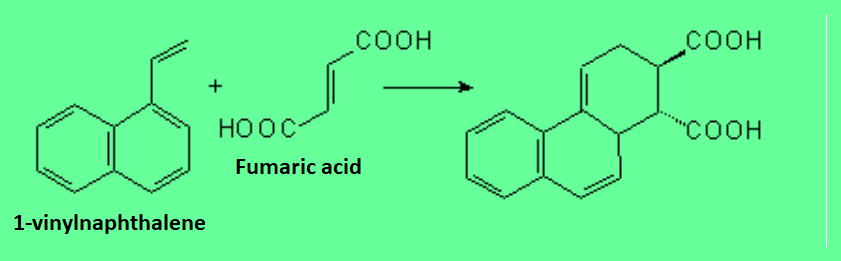
Although not easily, a diene with one of its double bonds within an aromatic system (styrene-like) can react with a highly activated dienophile such as fumaric acid.

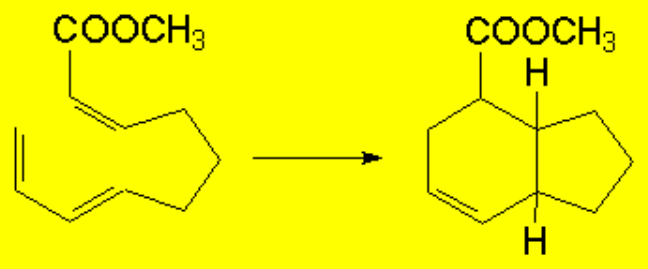
If the diene and the dienophile are in the same molecule and have the proper arrangement, the Diels-Alder reaction can take place intramolecularly.
