ortho-para Directors
Ortho-para directors can be either activators or weak deactivators.
Activating groups


The ring of aniline is so activated that its bromination takes place without a catalyst and is difficult to stop at the first step.
Could you anticipate the serious drawback of using a Lewis acid as a catalyst in this reaction? See the problems and exercises.


The orientation is ortho-para because the positive charge in the corresponding benzenonium ions is directly stabilized by resonance with the nitrogen's lone electron pair.
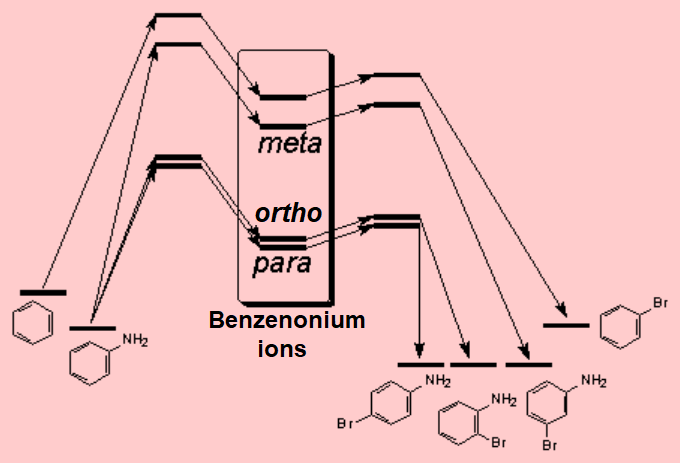
Aniline reacts faster than benzene, so its reaction pathways must lie at lower energies than benzene's. The ortho-para pathways are the lowest because in the corresponding benzenonium ions the positive charge is directly stabilized by the lone pair of the nitrogen.
Weakly deactivating groups
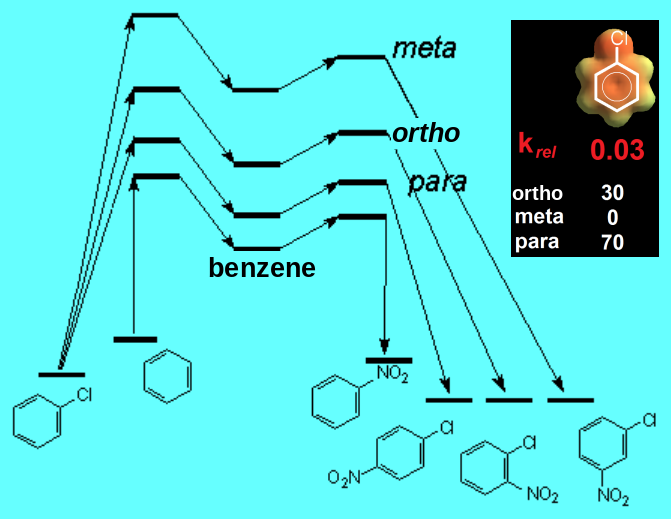
The best example is the halogens. Their electronegativity makes them withdraw some electron density from the ring, thus somewhat hindering the SEAr.

Despite the electron-withdrawing effect of the halogens, the ring still retains a reasonable electron density for the SEAr to proceed at a good rate.

Halobenzenes react more slowly than benzene. Consequently, their reaction pathways must lie above benzene's. The meta pathway should be the highest because in the corresponding benzenonium ion the halogen cannot interact directly with the positive charge and is thus unable to stabilize it. The additional stabilization of the ortho and para benzenonium ions (see above) makes these pathways lower in energy.