
Aromatic Halogenation
The price of an SEAr is the temporary loss of aromaticity. This is an energy cost that has to be compensated by increasing the electrophilicity of the attacking species.
 ▶ Watch the video on YouTube
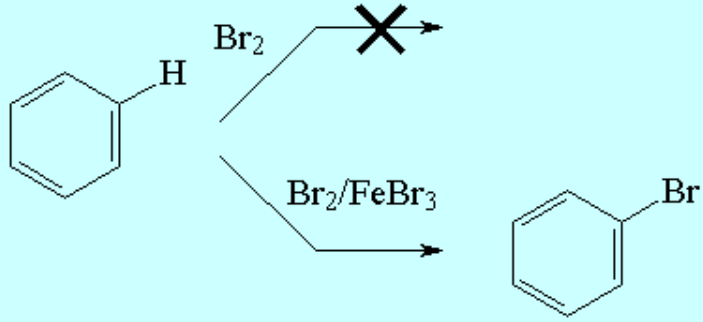
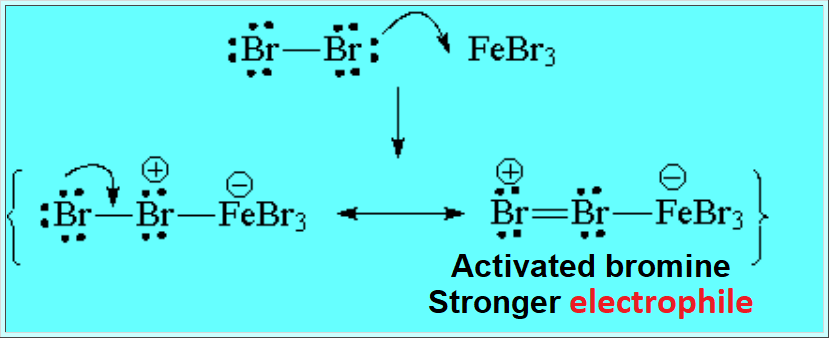
In bromination, the Br2 molecule has to be activated with FeBr3:
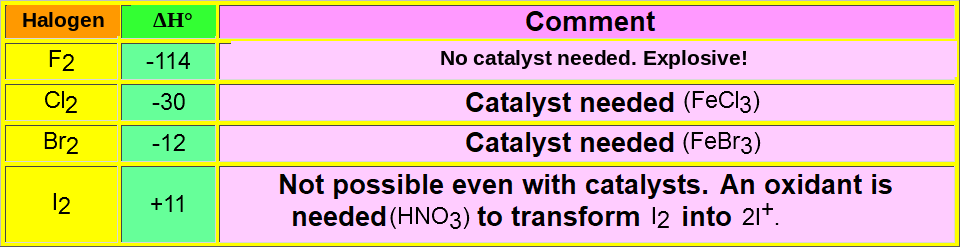
The thermodynamic balance of the reaction depends on the halogen used:
For instance, the energy diagram of chlorination is the following:
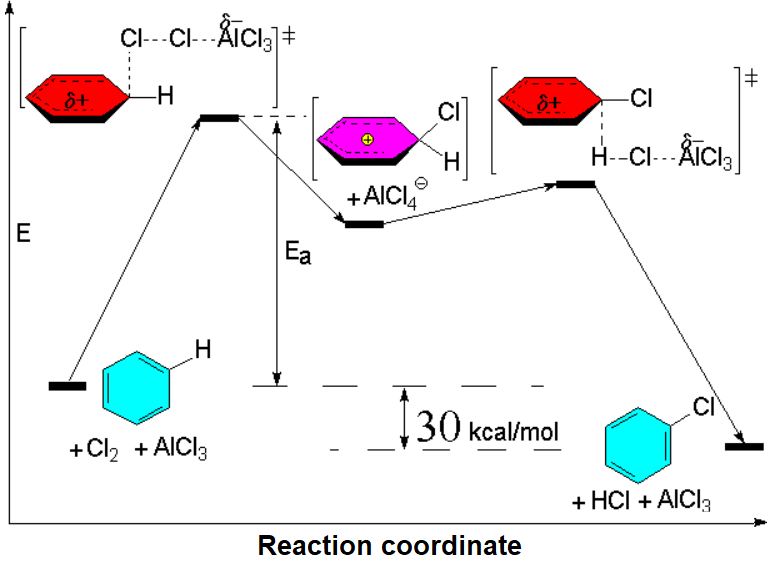
ΔH° = ΔH°(Cl–Cl) + ΔH°(H–C6H5) − [ΔH°(H–Cl) + ΔH°(Cl–C6H5)] = 58 + 111 − (103 + 96) = −30 kcal/mol
SEAr reactions are usually thermodynamically favorable.
Catalysts are used to make the activation energy surmountable, so that the reaction proceeds at a reasonable rate.