
SolutionsThe Third SEAr
1. Disubstituted benzenes
Predict the result of the following reactions:

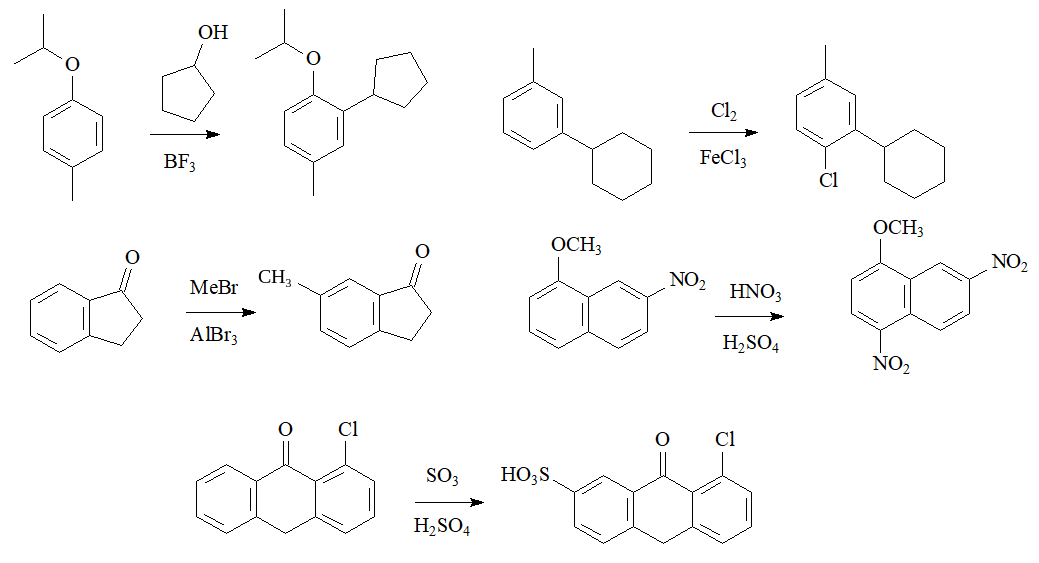
- The most activating group wins: isopropoxy over methyl, and methyl over cyclohexyl, because of steric hindrance.
- In indanone the carbonyl directs meta and the CH2 ortho-para: both influences coincide at position 6.
- In naphthalene the ring activated by the methoxy group reacts, at the free α position.
- In anthrone the ring not deactivated by chlorine is substituted.
2. Directing power
Rank these substituents in order of decreasing directing power: –CH3, –OH, –NO2, –Cl, –NHCOCH3.
–OH > –NHCOCH3 > –CH3 > –Cl > –NO2. When two groups compete, the more activating one wins.