Isocyanates
Isocyanates can be prepared by nucleophilic substitution with CYANATE. This ion is a very good nucleophile and a weak base and therefore it leads to typical SN2 reactions, unless the reacting carbon is too sterically hindered.


Isocyanates are intermediate compounds in the Hofmann rearrangement of amides. This rearrangement can be an alternative method of getting isocyanates.
Click here to go to the Hofmann rearrangement of amides.
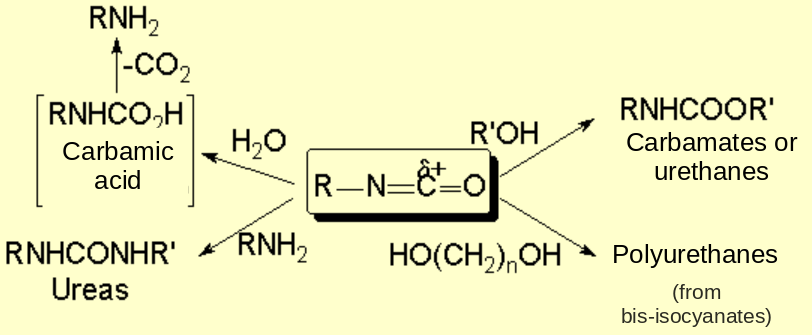
The isocyanate functional group bears a very electron-deficient carbon:

Due to that feature, the main reactions of isocyanates involve the nucleophilic attack on that carbon, yielding a large variety of new functional groups: