¹H–¹³C correlations
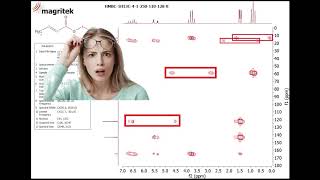
Heteronuclear two-dimensional spectra have 1H on one axis and 13C on the other. Each spot links a hydrogen to a carbon. Depending on the coupling they exploit, they relate each hydrogen to its own carbon (one bond: HSQC) or to neighbouring carbons (two or three bonds: HMBC). Together they make it possible to build the carbon skeleton.
From hydrogen to skeleton
COSY rebuilds chains of hydrogens, but it stops as soon as it meets a carbon without hydrogens, a heteroatom or a carbonyl. Besides, it says nothing about the carbons. 1H–13C correlations complete the information:
- They assign the carbon of each hydrogen, and with it its 13C shift, which tells us about its environment.
- They separate overlapping 1H signals, because their carbons usually have different shifts.
- They locate carbons without hydrogens (quaternary carbons, carbonyls, nitriles) through nearby hydrogens.
- They join fragments that COSY left apart.
One, two or three bonds
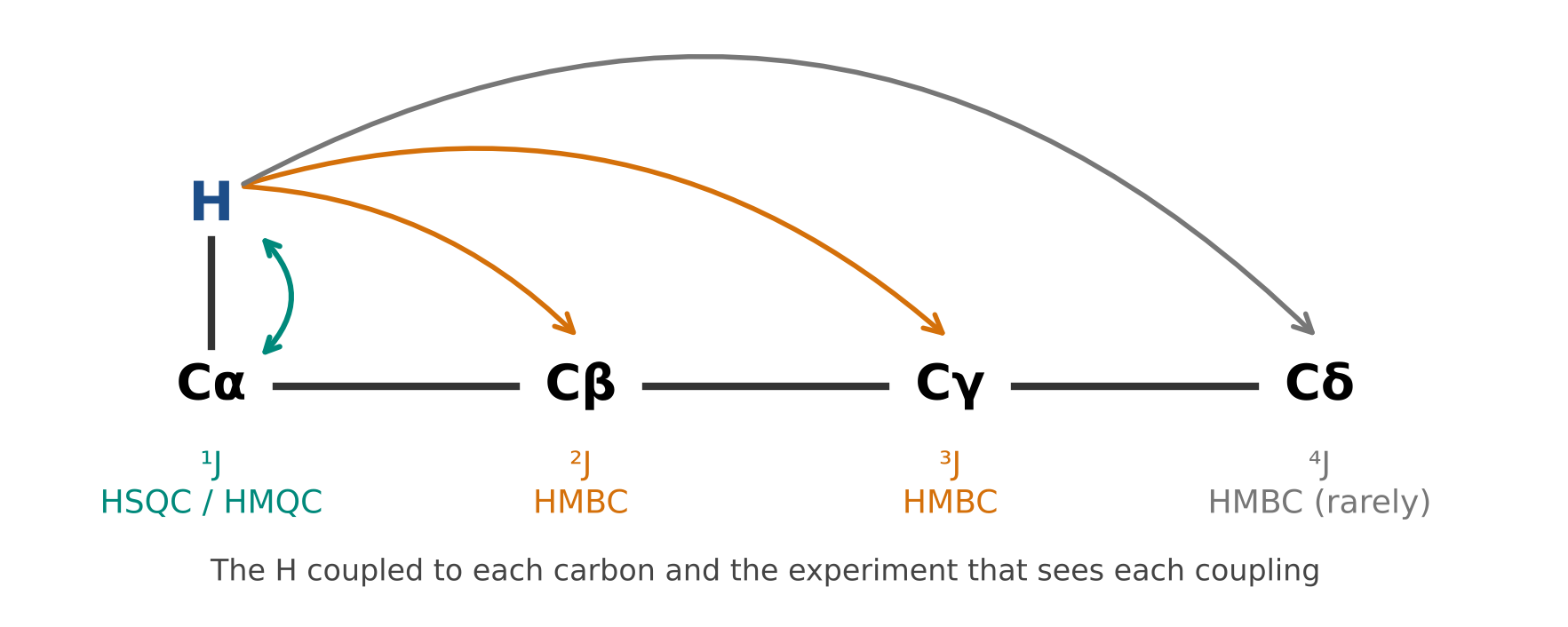
In topic 8 we saw that 13C couples to hydrogens one bond away (1JCH, 125 to 250 Hz) and, much more weakly, two and three bonds away (2JCH and 3JCH, 0 to 10 Hz). Two-dimensional experiments are tuned to exploit one type of coupling or the other:
| Experiment | Coupling | What it shows | Carbons that appear |
|---|---|---|---|
| HSQC / HMQC | 1JCH | each hydrogen with the carbon it is bonded to | only those bearing hydrogens |
| HMBC | 2JCH and 3JCH | each hydrogen with the carbons two and three bonds away | all, including quaternary carbons |
| INADEQUATE | 1JCC | each carbon with the carbons it is bonded to | all (but it is very insensitive) |
Inverse detection
HSQC, HMQC and HMBC are inverse-detection experiments: although they report on 13C, what is recorded is the 1H signal. Hydrogen is far more sensitive, so an HSQC provides the shifts of the protonated carbons in less time and with less sample than the 13C spectrum itself. Inverse detection has a difficulty: 99 % of the protons are bonded to 12C, which is inactive, and that huge signal must be removed so that we can see the 1 % that are bonded to 13C. The pulse programs (with phase cycling or field gradients) are designed to “confuse” that 99 % of 1H–12C and make it disappear. Carbons without hydrogens are only seen in the HMBC.
To solve a structure by two-dimensional NMR, four spectra are combined. COSY gives the hydrogen chains, HSQC puts a carbon on each hydrogen, HMBC joins the fragments through the carbons without hydrogens and NOESY provides the stereochemistry.