
Examples of IR spectra
The best way to learn to read IR spectra is to look at many of them. This page discusses six compounds with different functional groups and, at the end, solves a problem by combining the IR spectrum with the molecular formula.
The spectra on this page are schematic: they show the main bands at their correct positions, but widths and intensities are approximate. Next to each one is the real spectrum from the SDBS database of Japan's National Institute of Advanced Industrial Science and Technology (AIST), with all its bands and the wavenumbers of the minima.
An ester: ethyl acetate
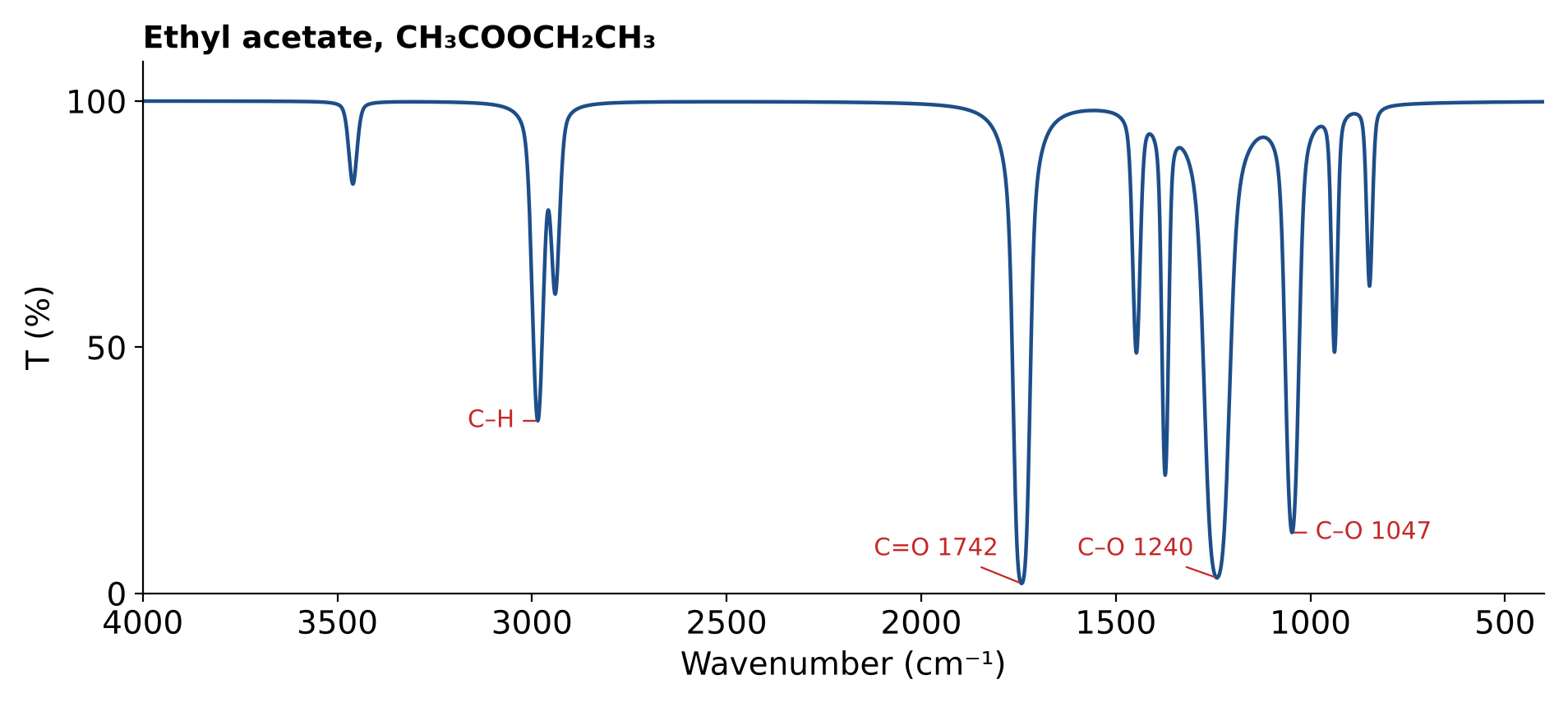
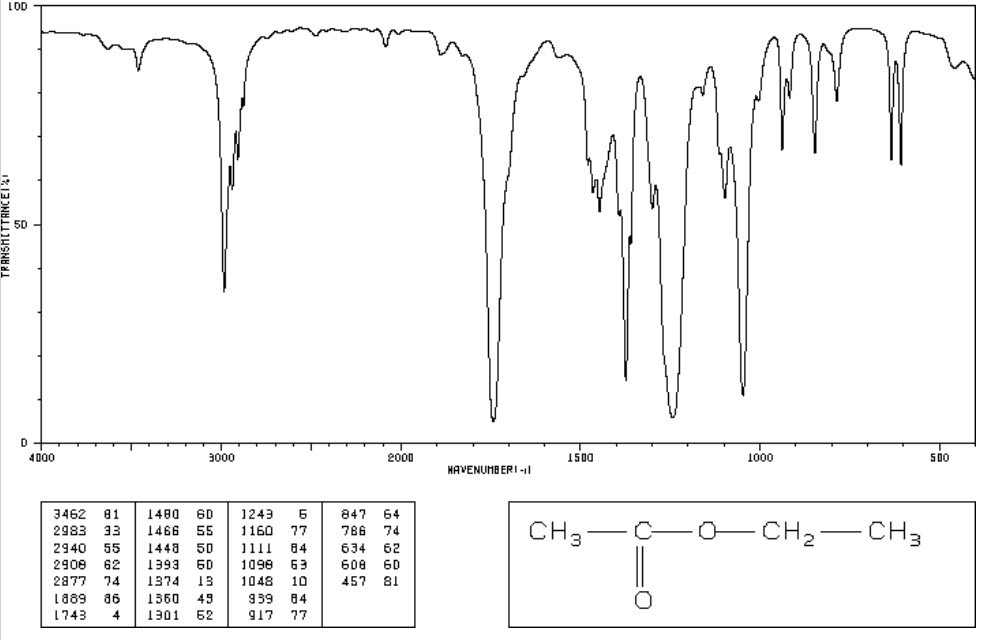
The carbonyl appears at 1742 cm−1, somewhat higher than in a ketone. What identifies the ester are the two C–O bands, both very strong: the one at 1240 cm−1, from the C(=O)–O bond, and the one at 1047, from the O–CH2 bond. There is nothing above 3000 cm−1, apart from a weak carbonyl overtone near 3460.
An aromatic aldehyde: benzaldehyde
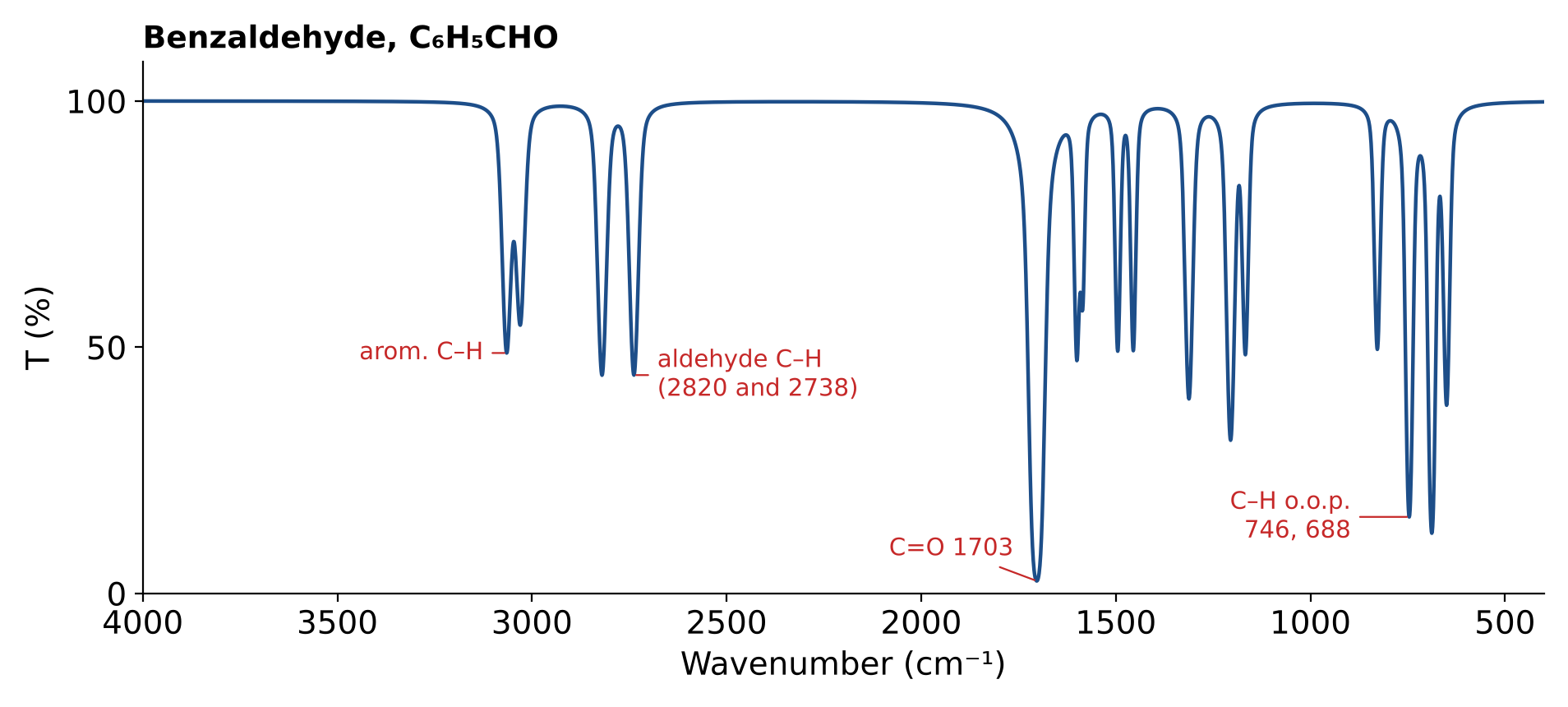
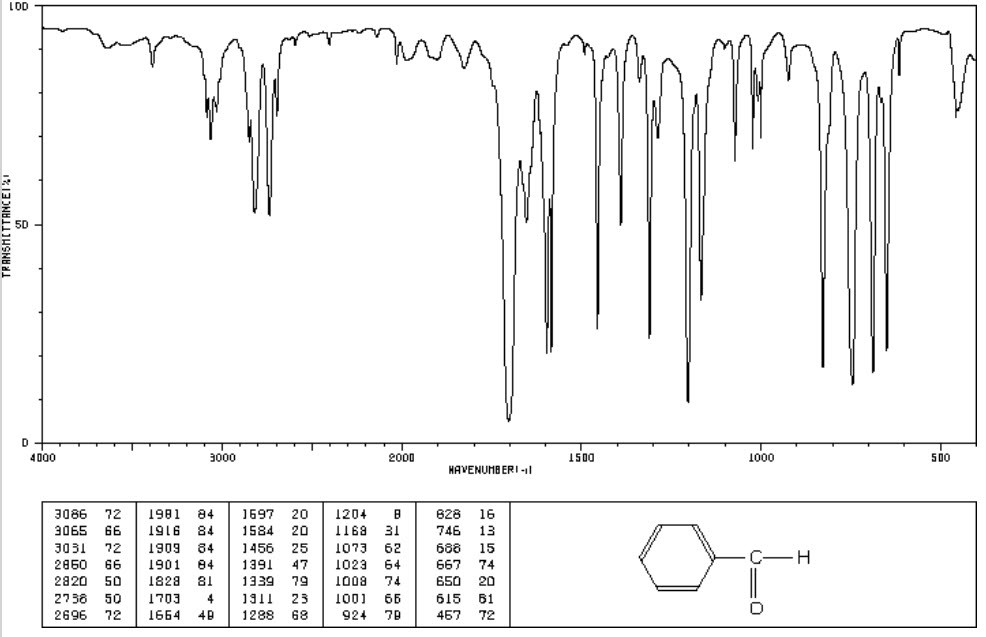
Three groups can be recognized here at once. The aromatic ring gives the =C–H stretch just above 3000 cm−1, the sharp bands at 1600 and 1455, and the two out-of-plane bends of a monosubstituted benzene (746 and 688). The aldehyde group gives its characteristic pair of C–H bands at 2820 and 2738 cm−1, and the carbonyl, conjugated with the ring, drops to 1703 cm−1, about 25 cm−1 below an aliphatic aldehyde.
A conjugated ketone: acetophenone
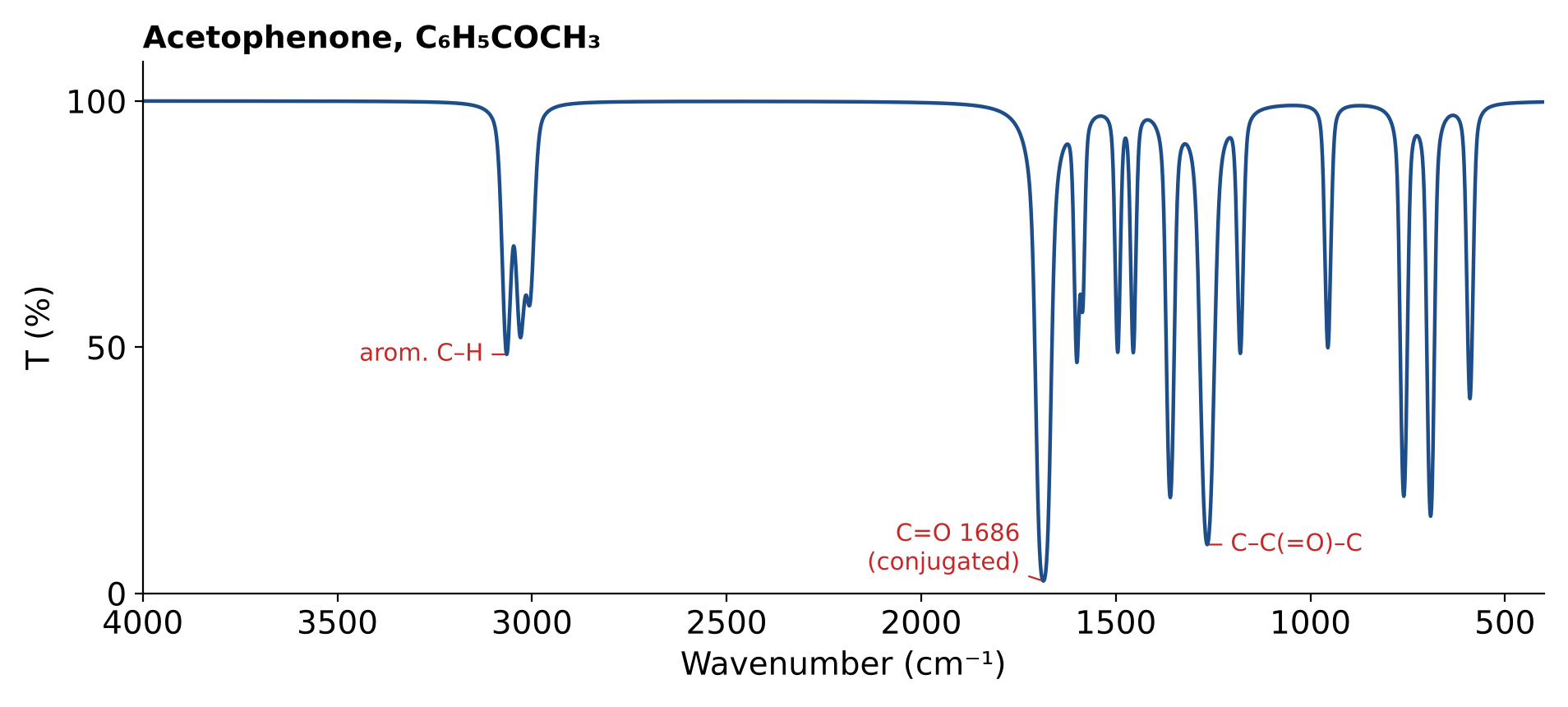
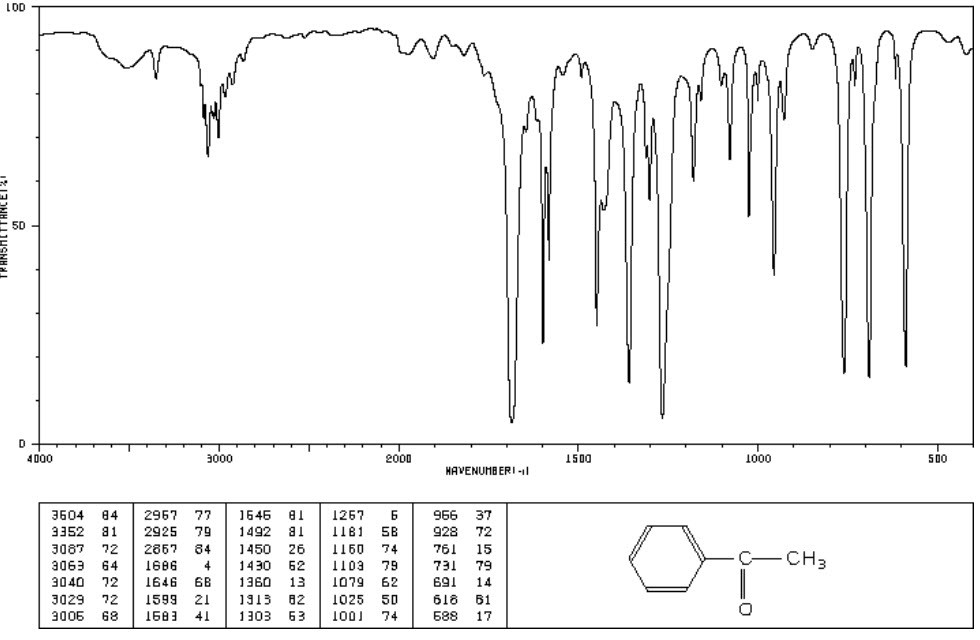
Acetophenone has the same ring as benzaldehyde, but the carbonyl belongs to a ketone: there are no bands near 2720–2820 cm−1, and the conjugated C=O appears at 1686 cm−1, compared with 1715 for acetone. The strong band at 1265 cm−1 is the stretch of the C–C(=O)–C skeleton, typical of aryl ketones.
A nitrile: benzonitrile
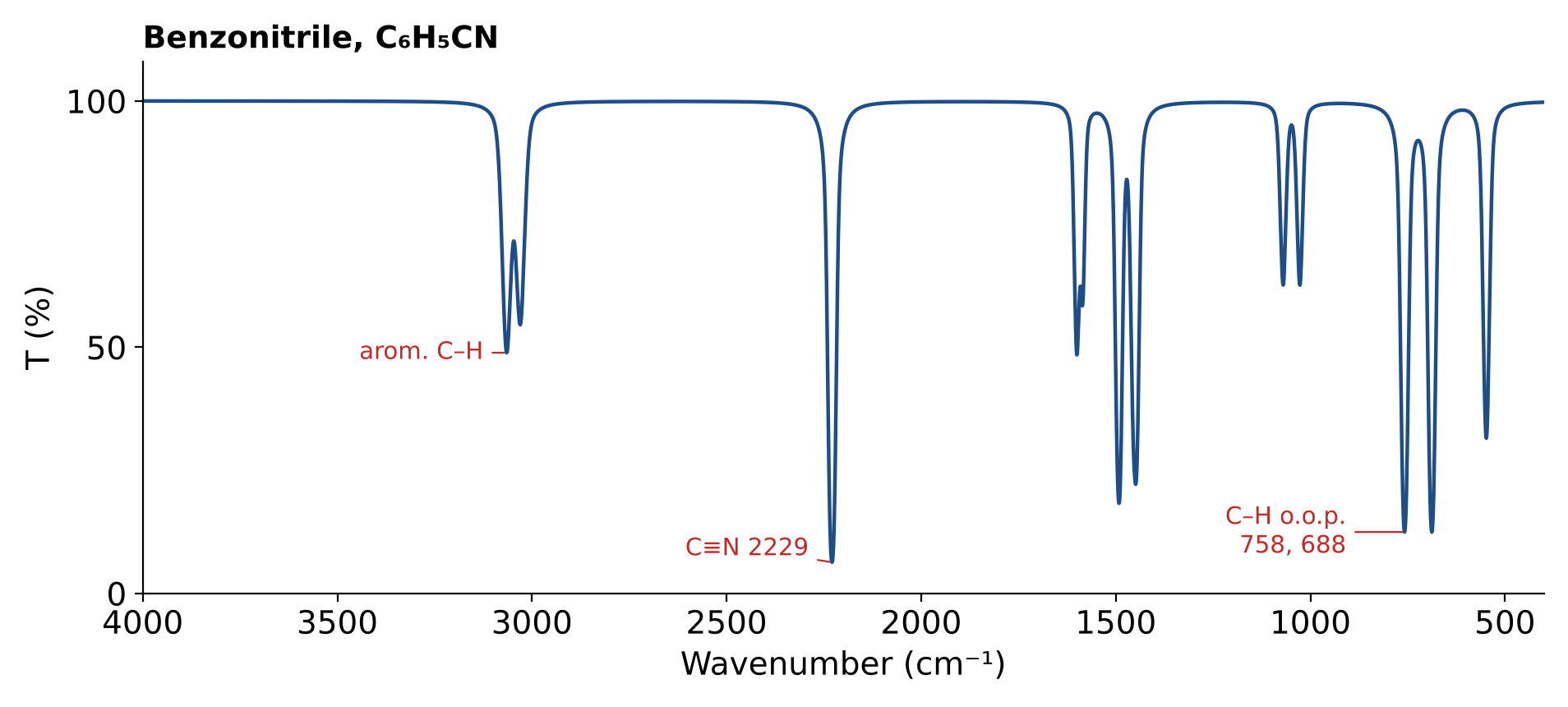
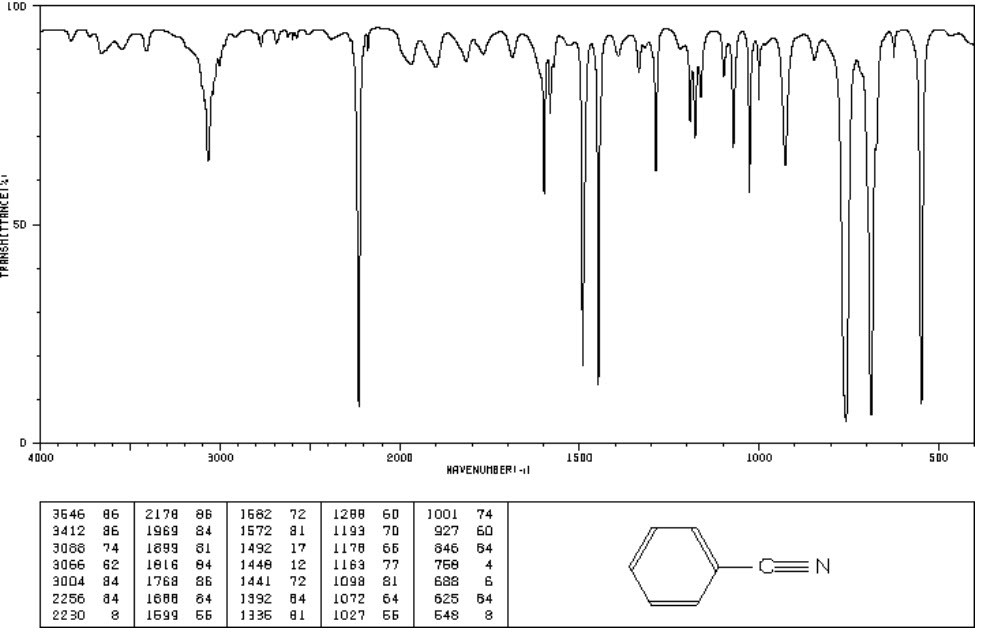
The sharp, strong band at 2229 cm−1, in a region where there is almost never anything, is enough to recognize the nitrile. It is stronger than that of an alkyne because the C≡N bond is polar. The rest of the spectrum is that of a monosubstituted benzene.
Phenols
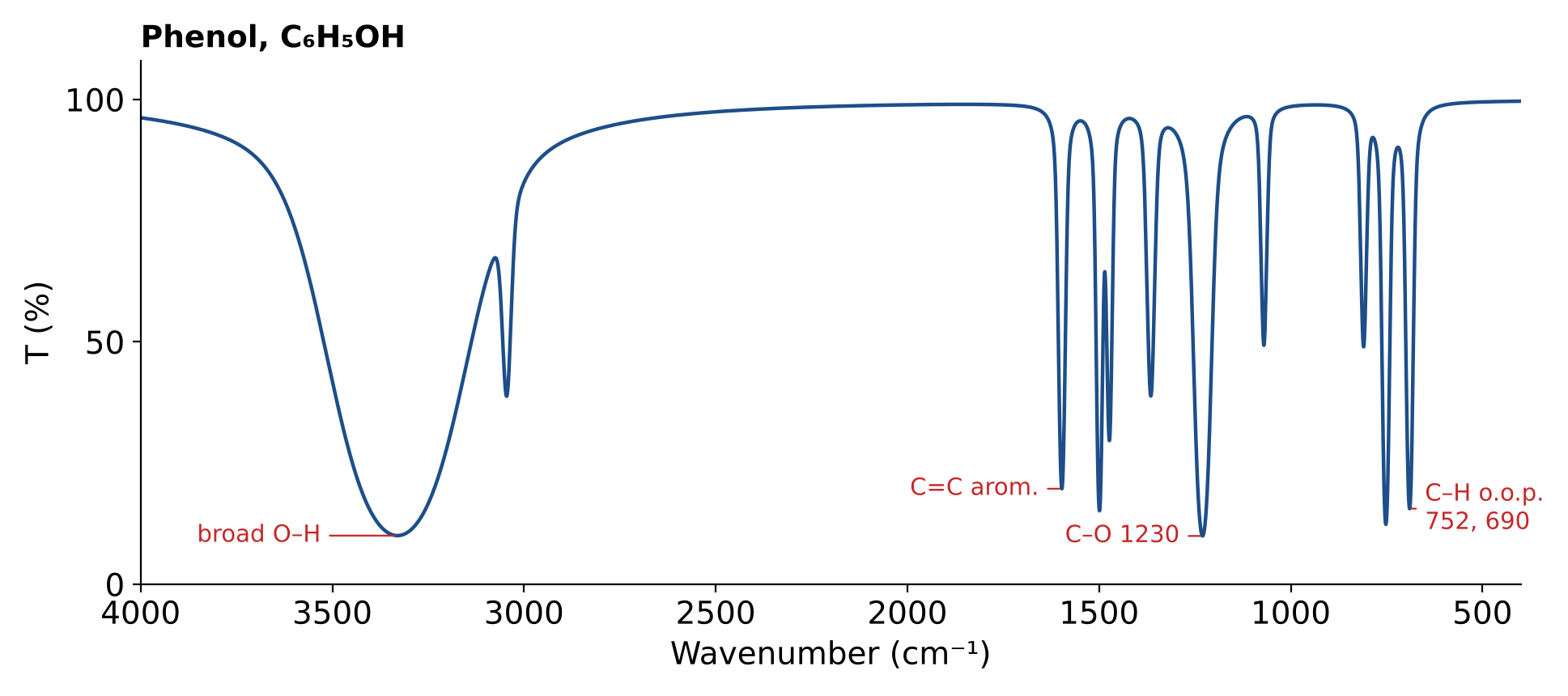
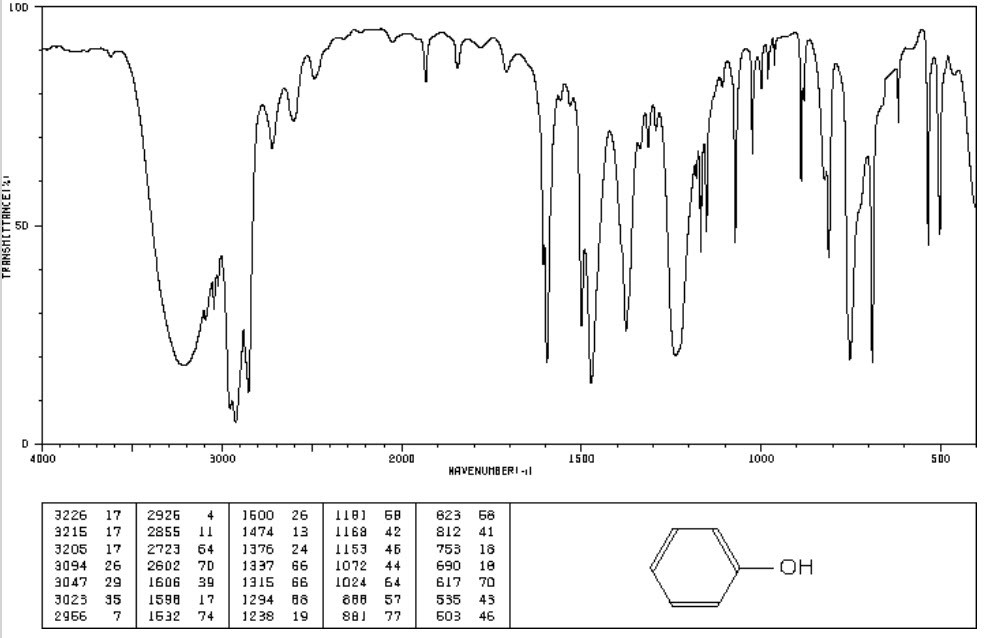
Phenol combines the broad O–H band of a hydrogen-bonded alcohol with the bands of an aromatic ring. The difference from an aliphatic alcohol lies in the C–O stretch, which appears at 1230 cm−1 instead of near 1050, because the C(sp2)–O bond is stronger.
The cresols
The three methylphenols, or cresols, have the same formula and the same functional groups, and in the functional-group region their spectra are very similar: all three have the broad O–H band near 3300–3400 cm−1, aromatic C–H stretches above 3000 and methyl ones below, and the ring bands near 1600 and 1500. The differences lie in the fingerprint region, above all in the C–H out-of-plane bends:
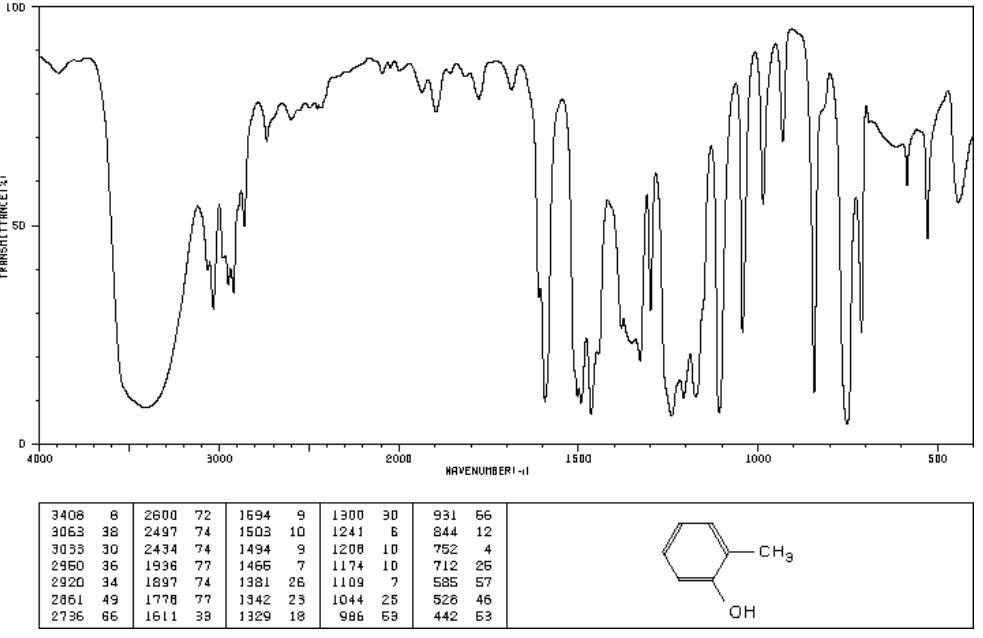
o-Cresol has four adjacent hydrogens on the ring and gives a single, very intense out-of-plane band at 752 cm−1, that of an ortho-disubstituted benzene.
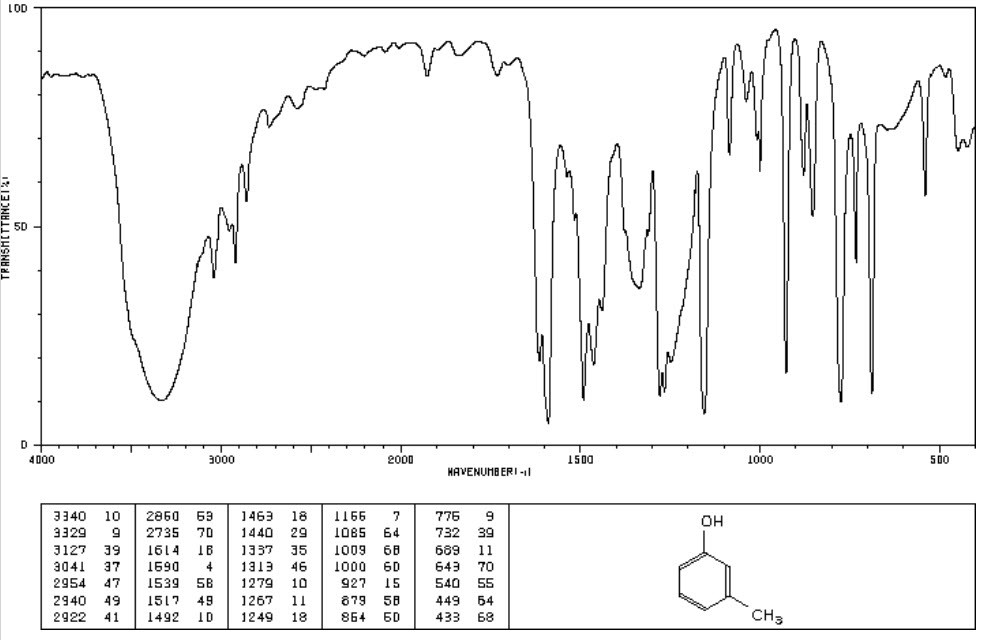
m-Cresol has three adjacent hydrogens and an isolated one between the two substituents. It gives two intense bands, at 776 and 689 cm−1, and a third, weaker one from the isolated hydrogen, at 927.
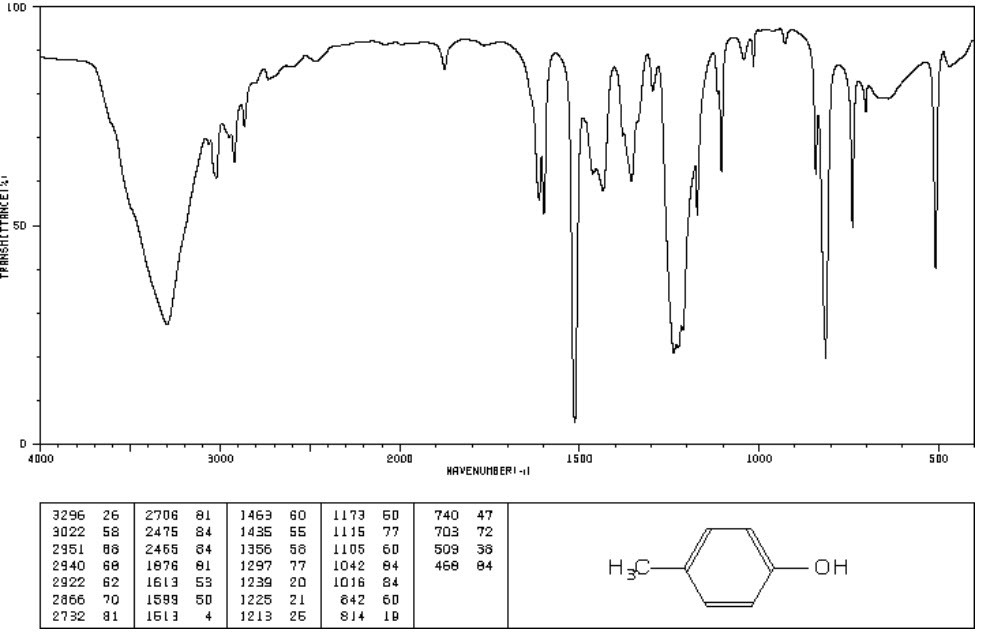
p-Cresol has two pairs of adjacent hydrogens and gives a single out-of-plane band at 814 cm−1, higher than that of the ortho isomer. Its ring band at 1513 cm−1 is very intense, as in many para-disubstituted benzenes with a donor group.
| Cresol | Adjacent ring H | C–H out-of-plane bends (cm−1) | C–O (cm−1) |
|---|---|---|---|
| ortho | 4 | 752 | 1241 |
| meta | 3 + 1 isolated | 776 and 689 (927) | 1279, 1267 |
| para | 2 + 2 | 814 | 1239, 1225 |
With the aromatic substitution table, the fingerprint region is enough to tell which of the three isomers it is.
A secondary amide: N-methylacetamide
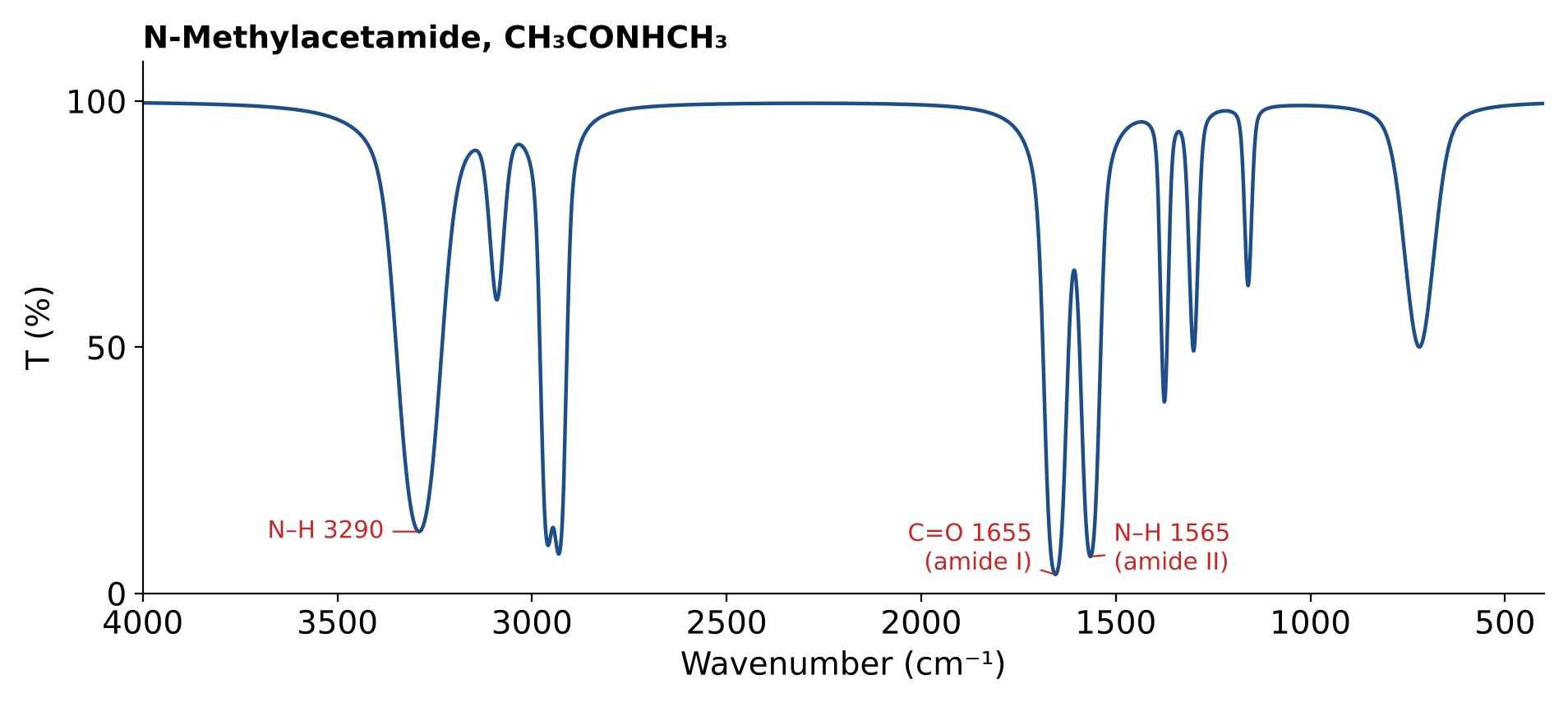
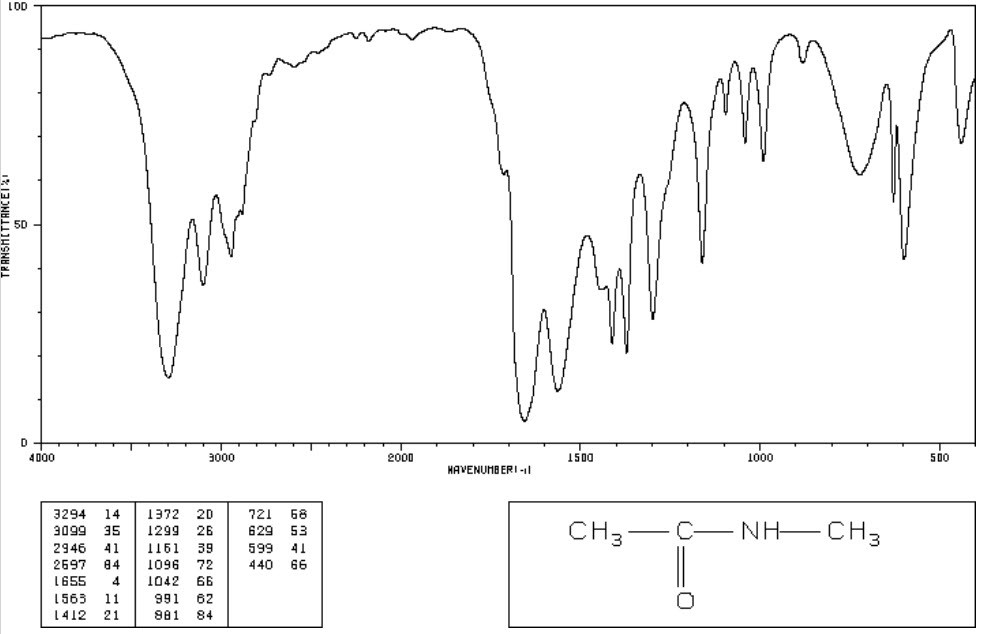
Secondary amides have a single N–H band, near 3300 cm−1, and two strong bands in the double-bond region: amide I (1655 cm−1), which is mainly the C=O stretch, and amide II (1565 cm−1), which combines N–H bending with C–N stretching. These same bands, in the peptide bond, are used to study the secondary structure of proteins.
From spectrum to structure
A compound with formula C8H8O (the one deduced from the exact mass in Exact mass, isotopes and molecular formula) gives an IR spectrum with bands at 3065 (w), 1686 (s), 1600 (m), 1450 (m), 1360 (m), 1265 (s), 760 (s) and 691 cm−1 (s). What is its structure?
- The formula has (2·8 + 2 − 8)/2 = 5 degrees of unsaturation (see Degrees of unsaturation). Four of them can be a benzene ring.
- The aromatic ring is confirmed by the =C–H stretch at 3065 cm−1, the bands at 1600 and 1450, and those at 760 and 691, which indicate a monosubstituted benzene.
- The fifth unsaturation is a carbonyl (1686 cm−1). Its position shows that it is conjugated.
- There are no O–H bands and no pair of aldehyde C–H bands (2820 and 2720 cm−1): it is a ketone.
With C6H5, C=O and the remaining atoms (one C and three H), the only possibility is acetophenone, C6H5COCH3. Phenylacetaldehyde (C6H5CH2CHO) would have an unconjugated carbonyl near 1725 cm−1 and the aldehyde C–H bands; 4-methylbenzaldehyde would also have those bands and a single out-of-plane bend near 810 cm−1.
A case as simple as this can be solved with IR alone, but usually IR tells which functional groups are present and NMR tells how they are connected. How to combine all the techniques is explained in A strategy for solving structures.