
Protection of alcohols
An alcohol is protected by converting it into an ether, an ester or an acetal: robust functions that remove its acidic proton, which is incompatible with organometallics, hydrides and strong bases.
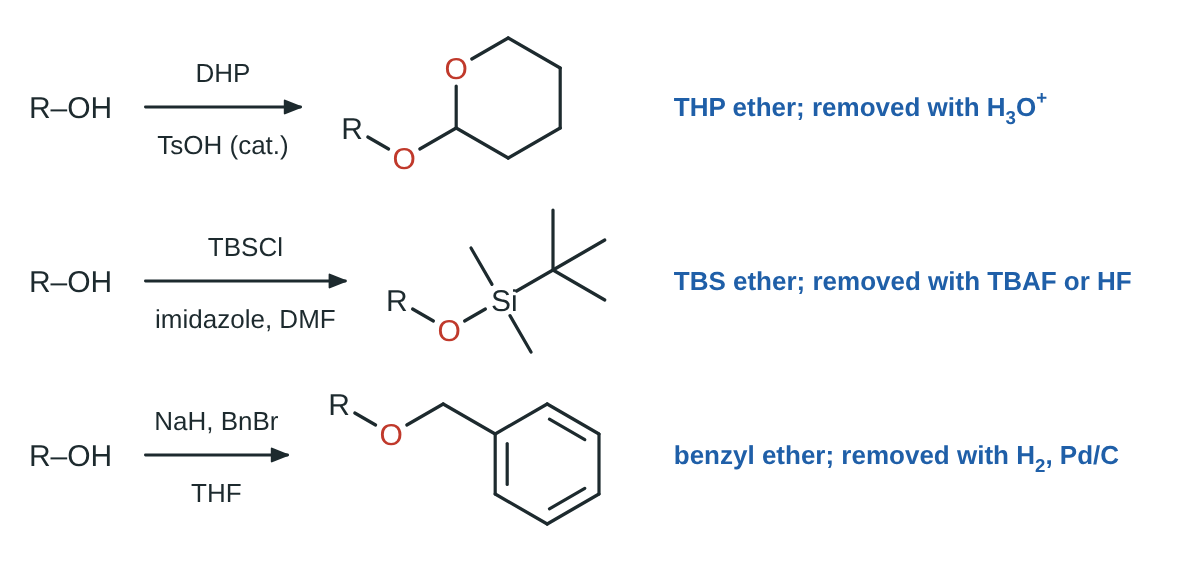
Ethers
- Tetrahydropyranyl (THP) ether: formed with 3,4-dihydro-2H-pyran (DHP) and an acid (TsOH or its pyridinium salt, PPTS). It is an acetal: stable to bases, organometallics and hydrides, cleaved by aqueous acid or acidic methanol. It creates a new stereocentre and gives mixtures of diastereomers.
- Methoxymethyl (MOM) ether: with MOMCl and a base; it is also an acetal and is removed with acid.
- Silyl ethers: the tert-butyldimethylsilyl (TBS or TBDMS) ether, introduced by Corey in 1972, is prepared with TBSCl and imidazole in DMF and removed with fluoride (TBAF or HF), owing to the great strength of the Si–F bond. Bulkier groups (TIPS, TBDPS) are more stable and allow primary and secondary alcohols to be distinguished.
- Benzyl (Bn) ether: with NaH and BnBr; it withstands acids, bases and organometallics and is removed by hydrogenolysis (H2, Pd/C). The p-methoxybenzyl (PMB) ether can also be removed by oxidation with DDQ.
- Allyl ether and tert-butyl ether: the first is isomerized to an enol ether with rhodium or palladium catalysts and hydrolysed; the second is formed with isobutene and acid and cleaved with trifluoroacetic acid.
Esters and acetals
Acetate (Ac), pivalate (Piv) and benzoate (Bz) esters are formed with the anhydride or acid chloride and pyridine or DMAP, and removed with base (K2CO3 in methanol, NaOH); they resist acids and oxidation, but not organometallics or hydrides. 1,2- and 1,3-Diols are protected together as acetonides (with acetone or 2,2-dimethoxypropane and acid) or as benzylidene acetals (with benzaldehyde), widely used in sugar chemistry.