
Protection of amines
Amines are nucleophilic and basic, and primary and secondary amines have acidic protons. They are protected as carbamates or amides, which delocalize the nitrogen lone pair, or by alkylation with groups that are later removed.
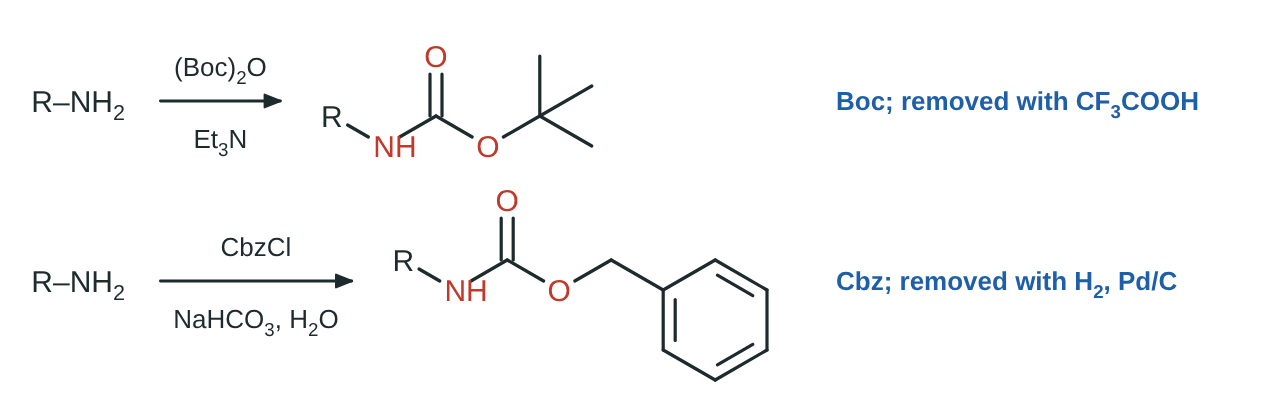
Carbamates
tert-Butoxycarbonyl (Boc) is introduced with di-tert-butyl dicarbonate, (Boc)2O, and removed with trifluoroacetic acid or HCl in dioxane, which form the tert-butyl cation, isobutene and CO2. Benzyloxycarbonyl (Cbz or Z), introduced by Bergmann and Zervas in 1932 for peptide synthesis, is attached with benzyl chloroformate and removed by hydrogenolysis. 9-Fluorenylmethoxycarbonyl (Fmoc) is removed with piperidine, a mild base. Boc, Cbz and Fmoc are mutually orthogonal and underpin solid-phase peptide synthesis.
Amides and alkylation
- Acetamides and trifluoroacetamides: the acetamide is very stable and requires vigorous hydrolysis; the trifluoroacetamide is cleaved by K2CO3 in methanol. In anilines, the acetamide also tempers the activation of the ring in SEAr.
- Phthalimides: they protect primary amines with both protons; they are released with hydrazine (as in the Gabriel synthesis).
- p-Toluenesulfonamides (Ts): very robust; removed with sodium in liquid ammonia or with hot strong acids.
- Benzylation, tritylation and benzylidenation: benzylamines are deprotected by hydrogenolysis; the very bulky trityl (Tr) protects primary amines and is removed with mild acid; benzaldehyde imines protect primary amines towards bases.