Skip to content
qorganica.es qorganica.comOrganic Chemistry made transparent Course map Español

Reactivity

Nitriles are attacked by nucleophiles, through a mechanism of "double addition-elimination".

Acid and basic hydrolysis

They lead to carboxylic acids.
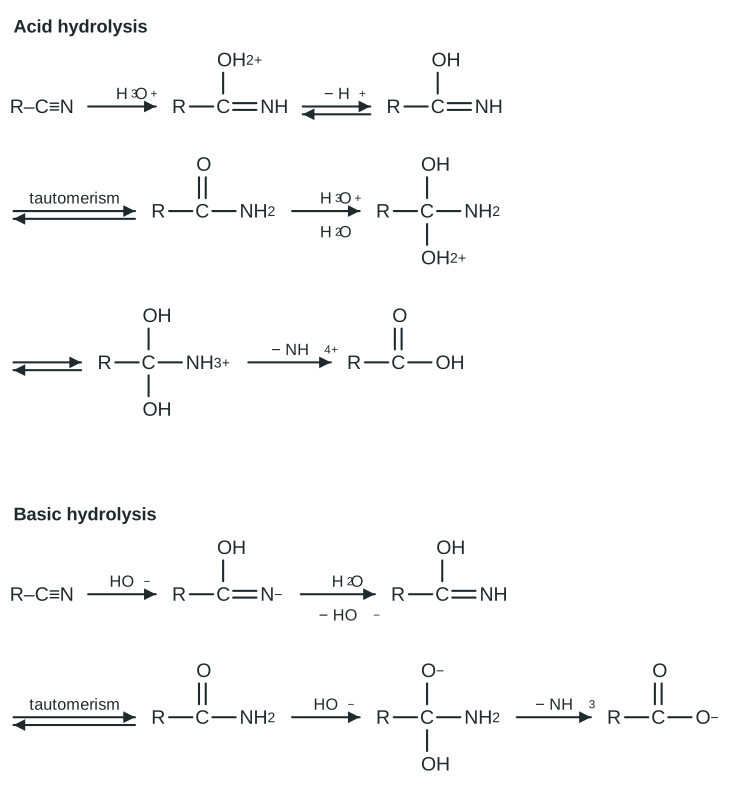
Mechanisms of the acid and basic hydrolysis of a nitrile: they go through the amide and end in the carboxylic acid or the carboxylate

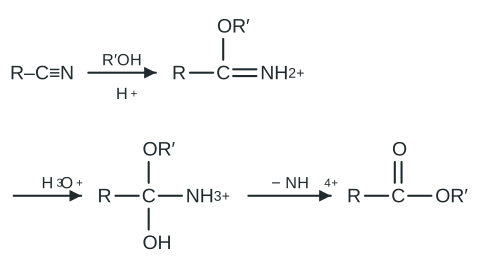
Alcoholysis

It yields esters.

Pinner reaction: a nitrile with an alcohol and acid gives an imidate that hydrolyses to the ester

Alcohols prone to give carbocations (tertiary, allylic, benzylic) react in a different way leading to amides.
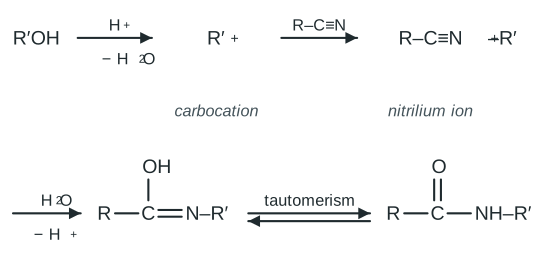
Ritter reaction: the carbocation formed from the alcohol adds to the nitrile and, after hydration, gives an N-substituted amide

Organometallics

Grignard reagents produce ketones.
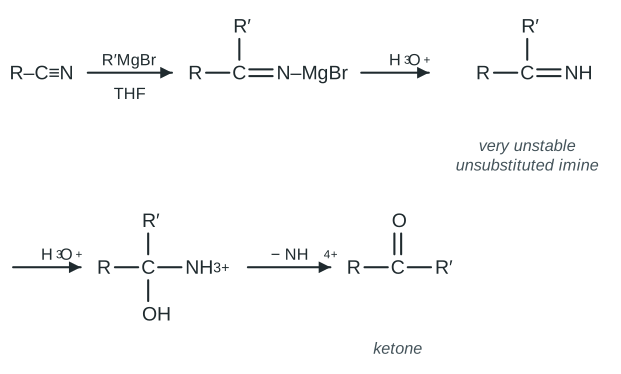
A nitrile with a Grignard reagent gives the imine salt, which hydrolyses to the ketone through a very unstable unsubstituted imine

Reduction

Partial reduction yields aldehydes whereas total reduction renders amines.
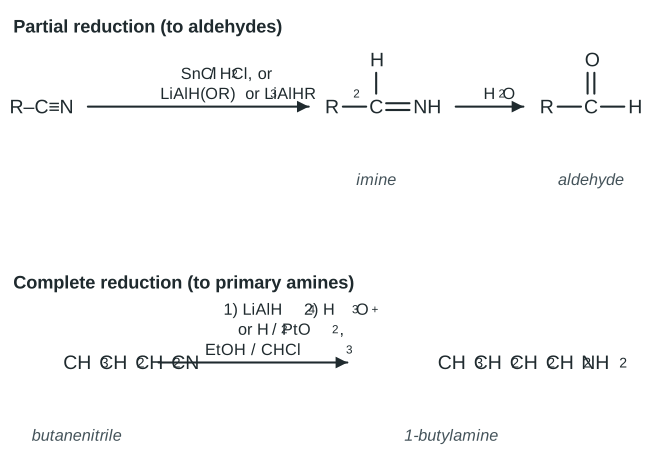
Reduction of nitriles: partial to aldehydes with SnCl₂/HCl or hindered hydrides, and complete to primary amines with LiAlH₄ or with H₂ and PtO₂