
A Complete Case: the Epothilones
The previous pages have presented, one by one, the separation methods and the spectroscopic techniques. This page sets them to work together on a real case: the path that leads from a handful of soil to a structural formula with seven stereocentres. The example is the epothilones, and the scheme — culture, extraction, purification, molecular formula, connectivity, configuration — is the same for any natural product.
Why These Molecules
Myxobacteria are soil bacteria that glide in swarms, build fruiting bodies and produce an extraordinarily rich secondary chemistry. In the 1980s, the microbiology group of Hans Reichenbach and the chemistry group of Gerhard Höfle, at the GBF research centre in Braunschweig, set up a systematic programme: isolate strains, culture them, screen the extracts and determine the structure of everything that proved active.
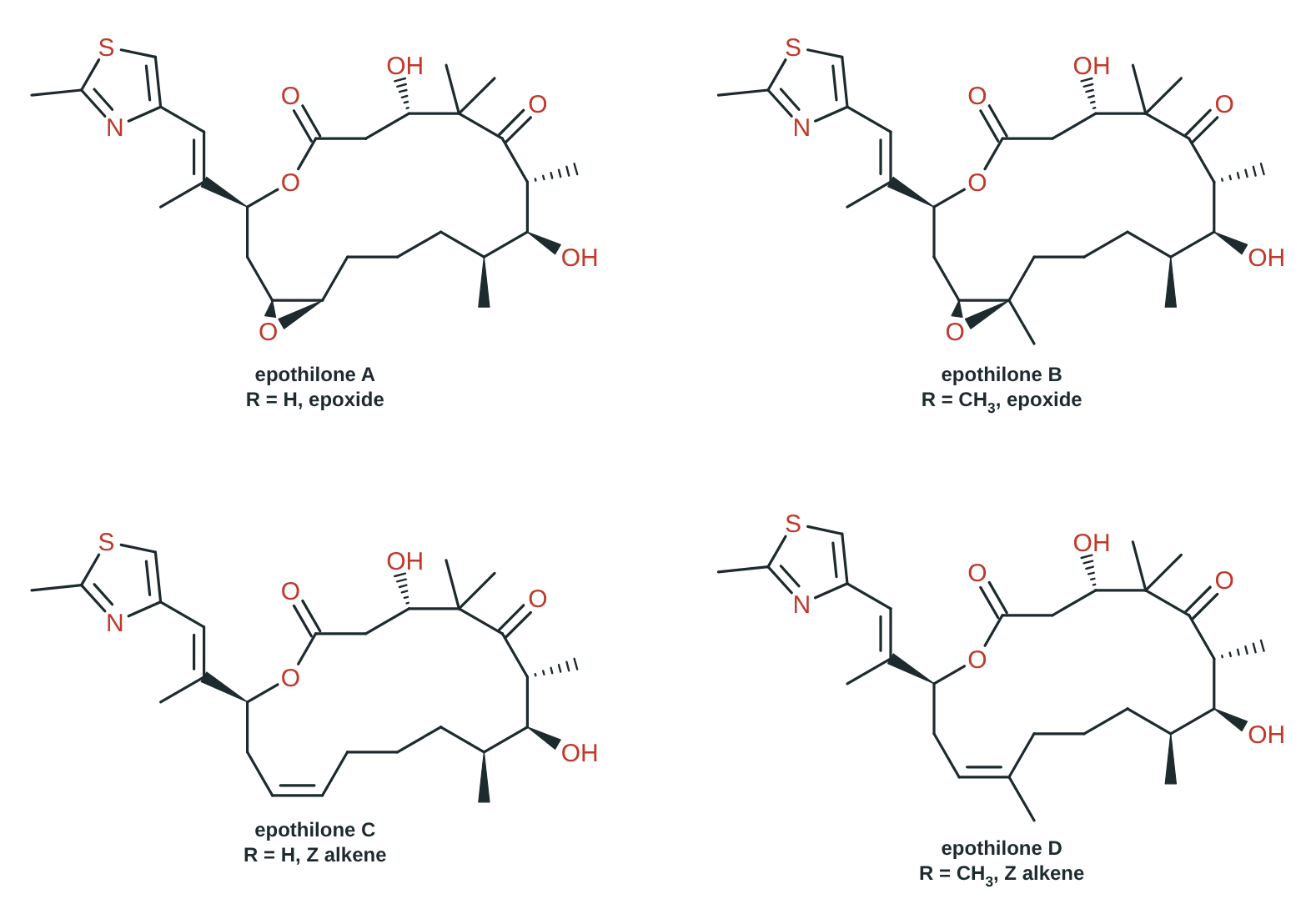
From a soil sample collected on the banks of the Zambezi River came the strain Sorangium cellulosum So ce90. Its extract killed fungi and, above all, was strongly cytotoxic. The complete structure was published in 1996, and the name epothilone sums up what could be seen in it: epoxide, thiazole and ketone. Shortly before, a group at Merck had discovered that these molecules act like taxol: they stabilize microtubules and block cell division.
The Scheme of Work
Every natural product isolation goes through the same six stages. What changes from one case to another is the scale, the number of columns and how many of the final techniques are needed.
- Culture: fermentation of the strain under reproducible conditions, following the activity of the broth with a simple bioassay.
- Extraction: separating the metabolites from the medium and the cells.
- Purification: successive chromatographies, each with a different separation principle.
- Molecular formula: exact mass and elemental analysis.
- Connectivity: IR, UV and, above all, one- and two-dimensional NMR.
- Configuration: NOE, chiral derivatives, chemical degradation and X-ray diffraction.
1. Culture and the Yield Problem
Sorangium cellulosum grows slowly: a fermentation takes days, and the concentration of epothilones in the broth is a few milligrams per litre. Worse still, the metabolites are themselves toxic to the bacterium that makes them and degrade in the aqueous medium.
The solution was to add a non-ionic polystyrene adsorbent resin to the fermenter. The lipophilic compounds adsorb as soon as they are formed: they are removed from the medium, stop inhibiting the bacterium, are protected from hydrolysis and, incidentally, end up already concentrated on an easily filtered solid. This is in situ product removal, a tactic worth remembering whenever a metabolite is unstable or inhibitory.
The amount available conditions everything that follows. With a few milligrams a proton NMR spectrum can be measured; for a 13C spectrum with a good signal-to-noise ratio, or for crystallization, tens of milligrams are needed, and that means hundreds of litres of culture.
2. From the Resin to the Crude Extract
The resin is separated from the broth by filtration and eluted with an organic solvent. The eluate is concentrated under vacuum, leaving a dark oil that contains, besides the epothilones, lipids, pigments and dozens of other metabolites. A liquid–liquid partition between solvents of different polarity, like the one described on the extraction page, removes much of the excess in one step.
Throughout the operation one must keep track of where the activity is. The sample is divided, each fraction is assayed and work continues only with the one that kills cells: this is bioassay-guided fractionation, the guiding thread of every isolation of an active product.
3. Purification
No single chromatography can resolve such a complex mixture on its own. Several are chained together, and the rule is that each should separate by a different principle. The fundamentals of each technique are on the chromatographic methods and crystallization pages.
| Technique | Separates by | What it removes |
|---|---|---|
| Liquid–liquid partition | solubility | salts, sugars, very apolar lipids |
| Silica gel column | polarity (adsorption) | most of the coloured matter |
| Size exclusion (Sephadex) | molecular size | polymers and small molecules |
| Preparative reversed-phase HPLC | hydrophobicity | the closely related analogues |
| Crystallization | packing in the lattice | the last traces; gives crystals for X-ray |
The difficult step is the last one before crystallization. Epothilones A and B differ by a single methyl group, and C and D are their deoxy analogues: all four come off the silica column together and only reversed-phase HPLC separates them cleanly. Such families of very close analogues are the rule, not the exception, in secondary metabolism.
4. The Molecular Formula and the Degrees of Unsaturation
With the pure compound in hand, the first question is how many atoms it has. High-resolution mass spectrometry gives the exact mass of the molecular ion to four decimal places, and of all the possible combinations of C, H, N, O and S only one fits within the error of the instrument. For epothilone A the answer is C26H39NO6S; for B, C27H41NO6S, exactly one CH2 more.
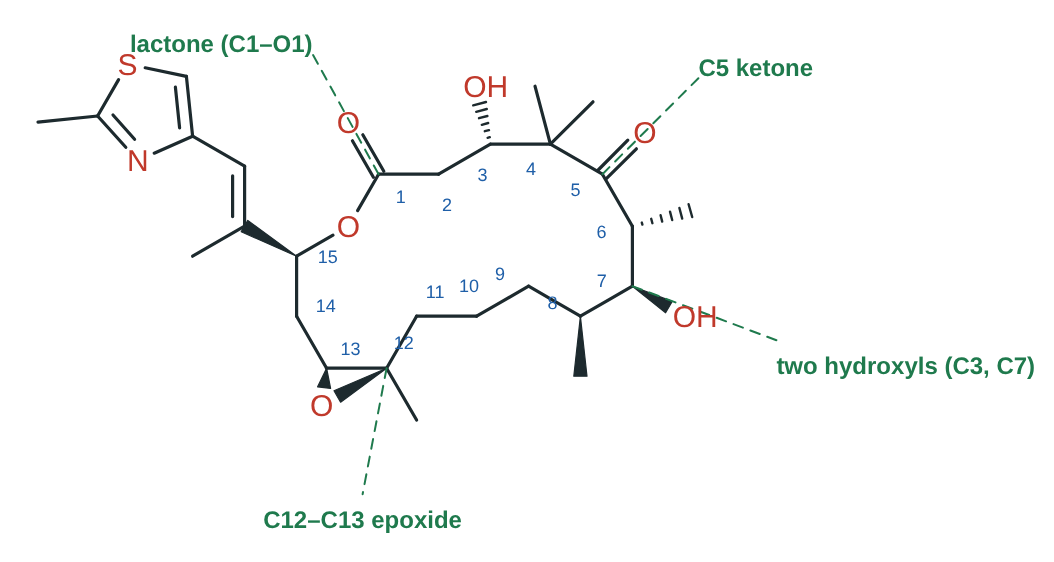
From the formula the degree of unsaturation is calculated. For C27H41NO6S: (2 × 27 + 2 + 1 − 41) / 2 = 8. Eight unsaturations must be placed: the thiazole ring accounts for three, the side-chain double bond for one, the lactone and the ketone for one each, the epoxide for another and the macrocycle for the eighth. This count, made at the outset, imposes a discipline on every structure proposed afterwards.
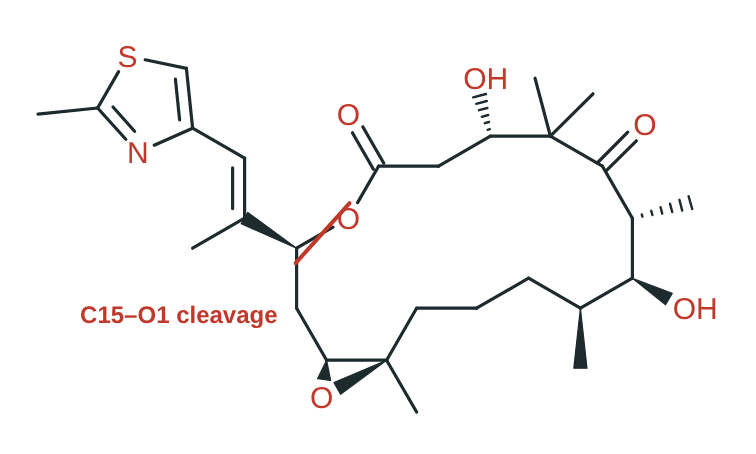
Fragmentation adds further information. Cleavages occur where the bond is weakest or the resulting fragment most stable: in a macrolide, the C–O bond of the lactone is the natural candidate, and the fragment that retains the side chain with the thiazole identifies that part of the molecule.
5. The Functional Groups: IR and UV
The infrared spectrum is quick and says which groups are present, though not where. In the epothilones one sees the broad hydroxyl band around 3400 cm−1 and, in the carbonyl region, two distinct bands: that of the lactone ester, near 1740 cm−1, and that of the ketone, somewhat lower. That they appear separately already indicates two carbonyls of different kinds.
The ultraviolet spectrum looks for conjugated chromophores. A saturated chain does not absorb in the accessible region, so the absorption observed must come from the thiazole conjugated with the double bond of the side chain. UV alone would not have sufficed; combined with the sulfur and nitrogen of the molecular formula, it already points to a sulfur- and nitrogen-containing heterocycle.
6. Connectivity: One- and Two-Dimensional NMR
This is where the game is decided. The strategy is to count first and connect afterwards.
Counting
- The proton spectrum gives the number of hydrogens of each kind, their coupling constants and, from the region in which they appear, their environment: the two thiazole protons and the vinylic one at low field, those on oxygen-bearing carbon between 3 and 5 ppm, the swarm of methyls at high field.
- The carbon-13 spectrum counts the carbons. The two at lowest field are the carbonyls; that of the ester appears more shielded than that of the ketone, which confirms the reading of the IR.
- DEPT classifies each carbon as CH3, CH2, CH or quaternary. Adding up the hydrogens counted in this way and comparing with the molecular formula reveals those on heteroatoms: the two hydroxyl groups.
Connecting
- COSY correlates protons that couple to each other, that is, that sit on adjacent carbons. By following the cross-peaks one chains together spin systems: continuous pieces of molecule that end where the chain of hydrogens runs out.
- HSQC (or HMQC) links each proton with the carbon to which it is directly attached, and thus translates the proton fragments into fragments of the carbon skeleton.
- HMBC is the decisive piece. It correlates protons with carbons two and three bonds away, so it jumps over the carbons without hydrogen: the quaternary ones, the carbonyls, those of the heterocycle. It is these jumps that stitch the spin systems together and close the macrocycle.
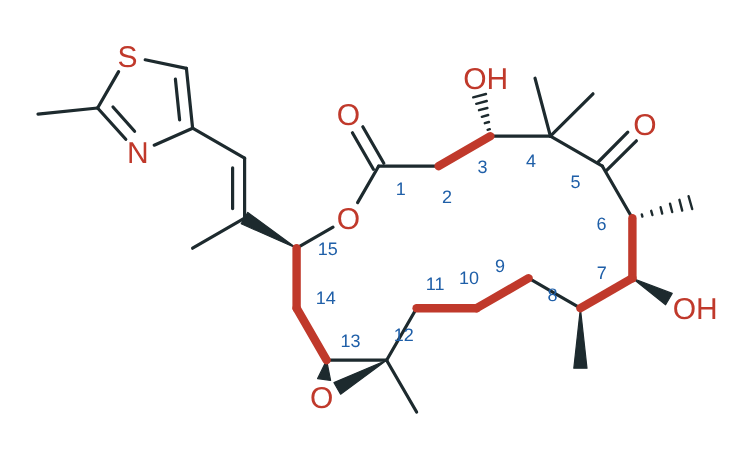
Note where the red traces break off: at the quaternary carbon bearing two methyl groups, at the two carbonyls and at the tetrasubstituted epoxide. A COSY, however good, leaves the molecule in four or five loose pieces; it is HMBC that says in what order they go.
The lactone deserves a comment. That the ester is cyclic is not apparent from the IR or the proton spectrum: it is deduced from the fact that the C15 proton, shifted to low field by the ester oxygen, correlates in the HMBC with the C1 carbonyl, which belongs to the other end of the chain. That single cross-peak closes the sixteen-membered ring.
7. Stereochemistry
The most laborious part remains. Epothilone B has seven stereocentres and a trisubstituted double bond: 27 = 128 possible stereoisomers, multiplied by two if the alkene geometry is counted. Two different things must be settled, and they should not be confused: the relative configuration (how the centres stand with respect to one another) and the absolute one (which of the two mirror images it is).
Relative Configuration
- Coupling constants depend on the dihedral angle (the Karplus equation) and distinguish cis and trans arrangements in rings and the geometry of double bonds.
- NOE (in a flexible macrocycle, better measured as NOESY or ROESY) reveals protons close in space even if they are far apart along the bonds. It is the main tool when there are no rigid rings.
- A sixteen-membered macrocycle is not rigid, so the distances measured are conformational averages. For that reason the relative assignment by NOE is in such cases considered a sound hypothesis, not a proof.
Absolute Configuration
Three routes are available, and in the epothilones all three were followed.
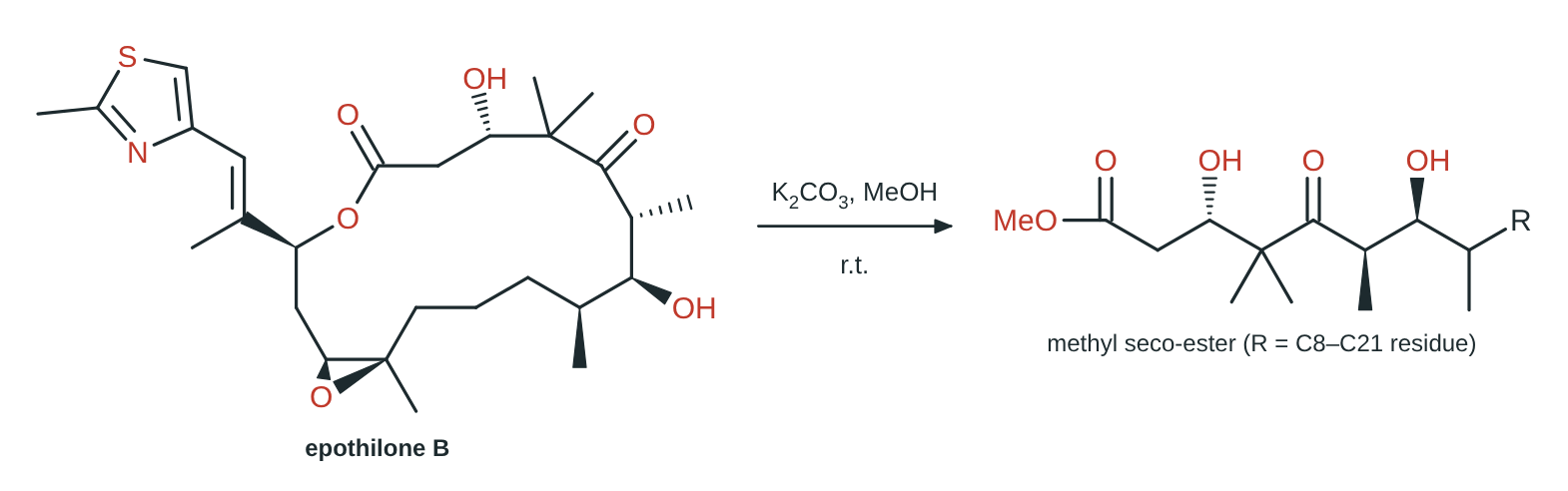
- Chemical degradation. The molecule is broken into manageable pieces that are compared with standards of known configuration. Methanolysis of the lactone opens the macrocycle: the resulting seco-ester is flexible, has much cleaner spectra and can be cut up further.
- Chiral derivatives. Mosher's method esterifies a secondary alcohol with both enantiomers of α-methoxy-α-(trifluoromethyl)phenylacetic acid (MTPA). The aromatic ring of the reagent selectively shields one side of the molecule; the difference in chemical shifts between the two esters, Δδ, has a different sign on either side of the carbinol, and that sign gives the configuration.
- X-ray diffraction. If the compound crystallizes, it settles at once the relative configuration and, with a heavy atom such as the sulfur of the thiazole, the absolute one as well. It is the definitive proof, and that is why so much effort goes into obtaining a good crystal.
8. The Final Proof: Synthesis
A structure is regarded as proved when someone synthesizes it from simple materials and the product is indistinguishable from the natural one in all its properties, including the optical rotation. The epothilones passed that test very quickly: the groups of Samuel Danishefsky, K. C. Nicolaou and Dieter Schinzer completed the first total syntheses between 1996 and 1997, barely months after the structure was published.
Synthesis does more than confirm: it opens the door to analogues. As the routes were convergent, changing one fragment sufficed to prepare dozens of variants and study which part of the molecule is needed for activity. Out of that work came ixabepilone, the lactam analogue of epothilone B, approved in 2007 for breast cancer.
The retrosynthetic analysis of epothilone, with its three disconnections and the ring-closing metathesis, is covered in topic 13 of the Advanced Organic Chemistry course.
What Applies to Any Natural Product
- Quantity rules. Before planning the experiments one must know how many milligrams are available.
- Each chromatography, a different principle. Running two silica columns in a row almost never improves on what the first failed to separate.
- Follow the activity at every step. It is the only way not to lose the interesting compound in a discarded fraction.
- Molecular formula first. The degrees of unsaturation are a constraint that no proposed structure may violate.
- Count before connecting. Proton, carbon and DEPT fix the inventory; COSY, HSQC and HMBC assemble it.
- HMBC bridges the gaps. Where there are no hydrogens, long-range correlations are the only possible connection.
- Keep relative and absolute configuration apart. NOE settles the first; for the second a chiral standard, a degradation or a crystal is needed.
- Synthesis is the court of last resort. Until the molecule is reproduced, the structure is a very well-founded proposal.
Timeline
| Year | Milestone |
|---|---|
| 1985–1987 | The strain Sorangium cellulosum So ce90 is isolated and the activity of its extract detected |
| 1993 | First patent on the epothilones as antifungal and cytotoxic agents |
| 1995 | A group at Merck discovers that they stabilize microtubules, like taxol |
| 1996 | Höfle and co-workers publish the complete structure, with the absolute configuration |
| 1996–1997 | First total syntheses (Danishefsky, Nicolaou, Schinzer) |
| 2007 | Ixabepilone, an analogue of epothilone B, is approved for breast cancer |
A complete course on how to determine organic structures is available, with the detail of each of the spectroscopic techniques only named here.