
Extraction
Extraction in Organic Chemistry is a separation technique that isolates a compound from a mixture (solid or liquid) by taking advantage of the different solubilities of its components in two immiscible solvents, usually water (neutral, acidic or basic) and an organic solvent.
Basic principle
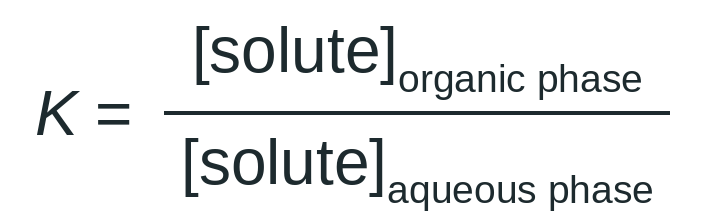
It is based on the partition coefficient (K), which indicates how a solute is distributed between two liquid phases in contact at a given temperature:
Main types
- Liquid-liquid extraction: the most common one in the laboratory. A separatory funnel is used to separate two immiscible liquid phases. The layers separate according to their density (the denser phase stays at the bottom). Click here for more information.
- Acid-base extraction: takes advantage of the acidic or basic character of organic compounds. Changing the pH with acids (HCl) or bases (NaOH, NaHCO3) turns the molecules into water-soluble ionic salts, so that carboxylic acids, phenols or amines can be separated from neutral components. Click here for more information.
- Solid-liquid extraction (leaching): the soluble compounds are extracted from a solid matrix with a solvent (for example, with a Soxhlet apparatus). Click here for more information.