
Facial control by the aldehyde
A stereocentre at the α position of the aldehyde orients the approach of the nucleophile. If its substituents are non-polar, the Felkin–Anh model applies; if one of them can form a chelate with the metal, the Cram chelate model applies, which gives the opposite diastereomer.
Facial selectivity adds to syn/anti selectivity, so if either the aldehyde or the enolate contains a stereocentre four stereoisomers are possible. There are four chair transition states: two give the syn product from the Z enolate and two the anti product from the E enolate. The two members of each pair differ in the face of the aldehyde that is attacked and give products of opposite configuration at both new stereocentres. If the aldehyde is racemic, the enantiomers are formed as well: eight stereoisomers in all.
The Felkin–Anh model
If the substituents on the α carbon are non-polar (alkyl or aryl groups), control is mainly steric. They are named by size: large (L), medium (M) and small (S). In the transition state, the large group lies perpendicular to the plane of the carbonyl, and the nucleophile enters from the opposite side, along the Bürgi–Dunitz trajectory (about 107° to the C=O bond); of the two conformations that meet this condition, the one in which the nucleophile passes next to the small group is preferred:
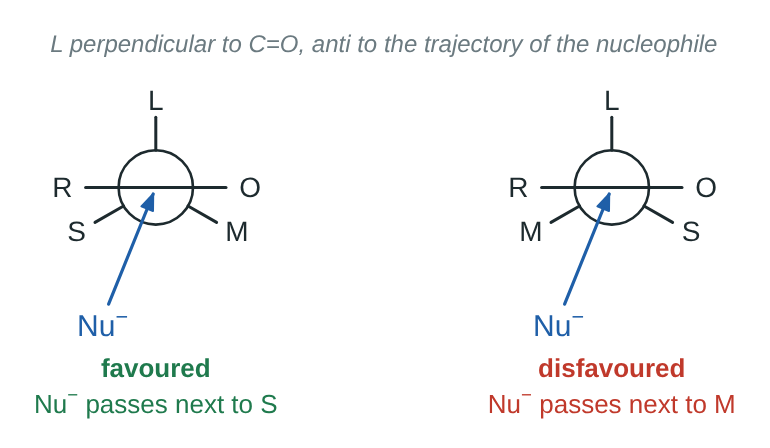
This model, proposed by Felkin (1968) and justified by Nguyen Trong Anh (1977), refines the old Cram rule (1952), which predicts the same major product for the addition of nucleophiles to carbonyls with an α stereocentre. In aldol additions it is combined with the Zimmerman–Traxler cyclic transition state.
Polar substituents and chelation
If the α substituent is an alkoxy group, there are two possibilities. With metals or Lewis acids capable of chelation (Mg2+, Zn2+, Ti4+, Sn4+), the metal binds both the carbonyl oxygen and the alkoxy oxygen and forms a five-membered ring that locks the conformation; the nucleophile then enters from the less hindered face, and the product is the opposite of the Felkin product (chelation product or anti-Felkin product):
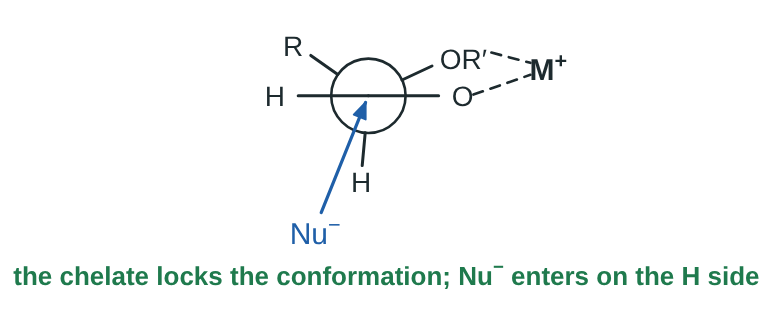
If the metal cannot chelate (BF3, boron enolates) or the alkoxy group is protected with a bulky group (a silyl ether), the electronegative group occupies the position perpendicular to the carbonyl, where its σ* orbital stabilizes the transition state, and the Felkin product is obtained again (polar Felkin–Anh model). With a β-alkoxy group, chelation forms a six-membered ring and favours the 1,3-anti relationship.
In summary, for an aldehyde R–CH(Yβ)–CH(Xα)–CHO reacting with an enolate:
| Situation | Model | Outcome |
|---|---|---|
| Xα alkyl or aryl; cyclic or open transition state | Felkin (steric) | 3,4-syn relationship |
| Xα alkoxy, chelating metal | Cram chelate | 3,4-syn relationship (the opposite of the polar model) |
| Xα alkoxy, no chelation | polar Felkin | Z enolate: 2,3-syn, 3,4-anti |
| Yβ alkoxy | chelate or polar model | 3,5-anti relationship |
The numbering refers to the aldol: C1 is the enolate carbonyl, C2 and C3 the new stereocentres, and C4 and C5 those of the starting aldehyde.