
Synthesis Strategies
Polysubstituted benzenes and other aromatic systems have to be prepared by carefully planned sequences of SEAr reactions.
 ▶ Watch the video on YouTube
One has to bear in mind the activating or deactivating and directing properties of the groups being introduced.
Unlike an arithmetic operation, in a synthetic sequence, the order in which the synthesis steps are planned DOES ALTER the product.
Trick 1
Some functional groups can be transformed into others, so that their activating and directing properties can be changed.
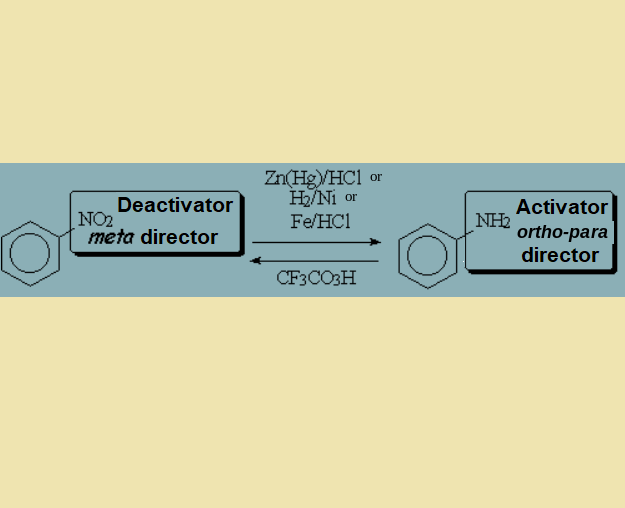
Conversion of an NO2 group, a strong deactivator and meta director, into an NH2 group, an activator and ortho-para director.
And vice versa.
But beware of acidic media, which transform NH2 into NH3+! All your plans would go down the drain.
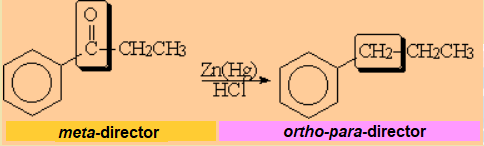
Conversion of a ketone group, a deactivator and meta director, into an alkyl group, an activator and ortho-para director.
Trick 2
Reversible sulfonation allows the temporary blocking of the para position.
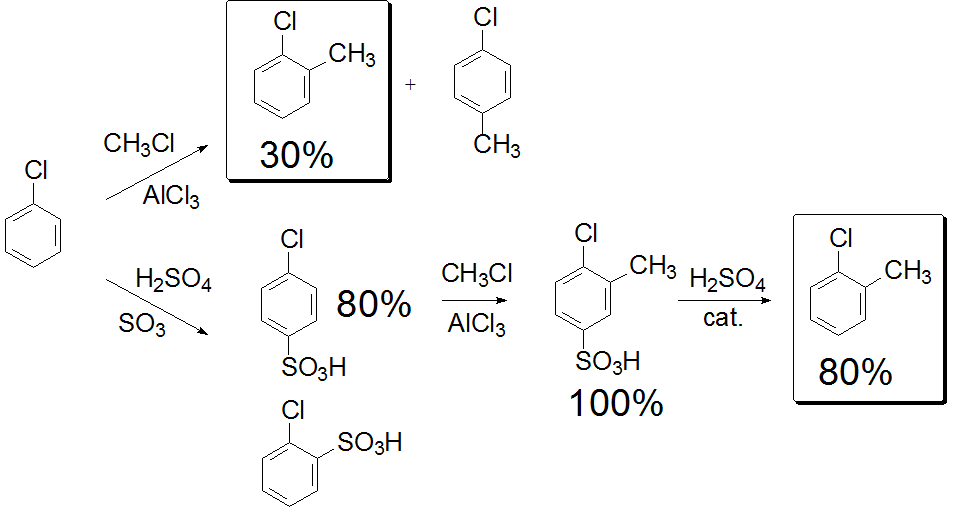
By "protecting" the para position, ortho-disubstituted compounds can be prepared more efficiently.
Trick 3
Transformation of an NH2 group into a diazonium salt.
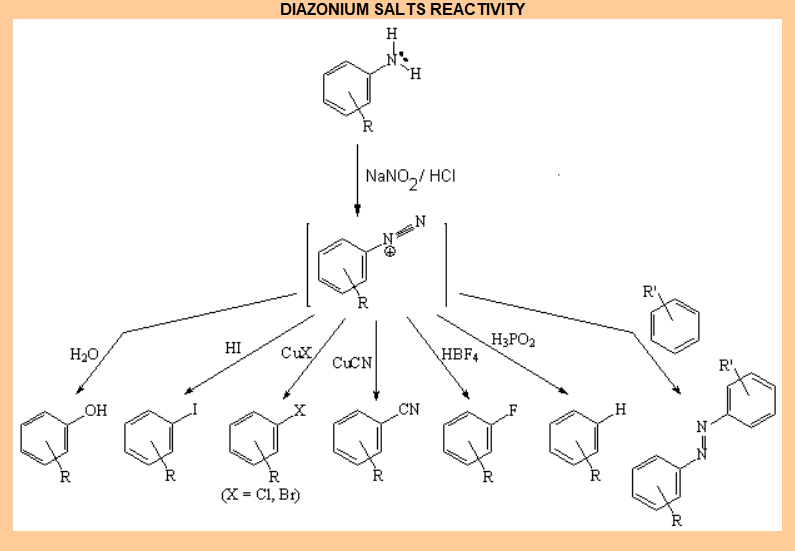
Diazonium groups can be replaced by a great number of other functional groups.