
SolutionsSynthesis Strategies
1. Synthesis from benzene
Propose a synthetic sequence for the following compounds, using benzene as the only aromatic precursor:

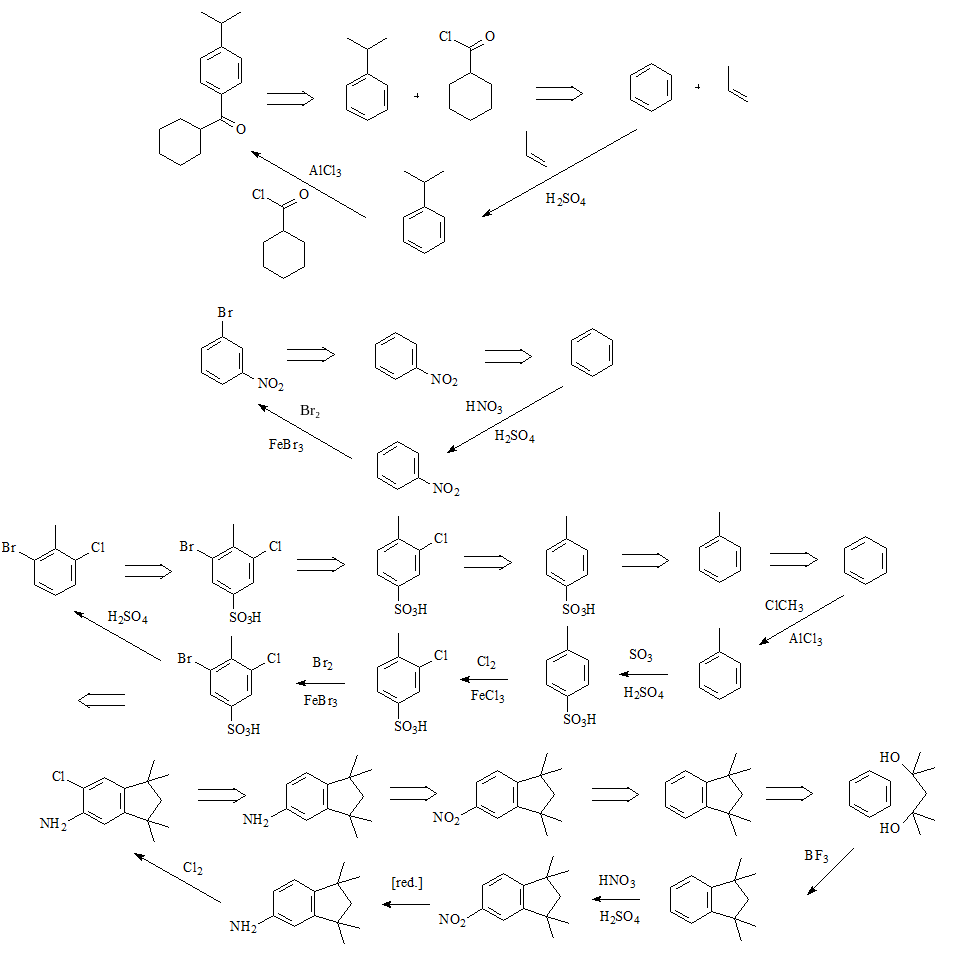
- Alkylation with propene and H2SO4 (cumene) and Friedel-Crafts acylation with cyclohexanecarbonyl chloride, which enters para.
- Nitration and then bromination: NO2 directs meta.
- Methylation (toluene), sulfonation (blocks the para position), chlorination and bromination at the two positions ortho to the methyl and, finally, removal of SO3H with dilute H2SO4.
- Double alkylation with 2,4-dimethylpentane-2,4-diol and BF3 (tetramethylindane), nitration, reduction to the amine and chlorination ortho to NH2.
2. Order matters
Propose syntheses of m-chloronitrobenzene and p-chloronitrobenzene from benzene.
- m-Chloronitrobenzene: nitration first, then chlorination (NO2 directs meta).
- p-Chloronitrobenzene: chlorination first, then nitration (Cl directs ortho-para); the major para isomer is separated.
3. Diazonium salts
How would you prepare 1,3,5-tribromobenzene from aniline?
1) Br2 in water: 2,4,6-tribromoaniline (NH2 activates so strongly that no catalyst is needed). 2) NaNO2/HCl: diazonium salt. 3) H3PO2: the diazonium group is replaced by H.